Focus on Vietnamese Tet Festival [Encore Publication]: A vibrant lunar new year celebration in America’s largest Vietnamese community

Most Americans are familiar with the Chinese New Year festivities that usher in the lunar new year in late January or early February, but most are not as aware of the Vietnamese cultural celebration of the start of the lunar year.  Called Tet, the Vietnamese new year’s festival has its own distinctive, bright, and colorful symbols and traditions.  By far the biggest Vietnamese community in the USA is in San Jose, California, which not coincidentally also hosts the largest Tet Festival each year in the US.  I’m fortunate to live quite near San Jose, and on the day of the Tet Festival I was already collaborating with a favorite model in a studio one city north of there, so I decided to drop by and shoot the Festival.  I’m very glad I did.  Today’s post presents some of my favorite images from the festival in the form of a simple photo essay.  I’ve included some discussion about how the images were made.

Welcome to the Tet Festival!  When shooting symbolic items, always check your background and find a point-of-view that is clean and compelling.  Buy this photo

An unusual cultural juxtaposition: Vietnamese belly dancing.  Here I used a fast shutter speed to freeze the motion and a relatively wide aperture to soften the background.  Capturing the right moment in the dance pattern is important, but it’s equally essential to capture the right facial gesture and eye contact.  Buy this photo

What’s scarier than a clown?  A drunken clown.  This fellow came out on stage with a bottle of beer and a bottle of whiskey, both of which he proceeded to drink onstage.  My wife and I suspect that this was an object lesson for the children in the audience, but we’re not certain.  Buy this photo

The fashion show of people watching the fashion show on stage.  Whether shooting landscapes, people, wildlife, or urban scenes, always remember to look in all directions.  Sometimes the most interesting subject lies in the opposite direction from the one you thought you were shooting.  Buy this photo

To capture this candid moment of young kids trying out the Vietnamese drums, I used a medium telephoto lens.  Most of the time I prefer to approach subjects before photographing them, but occasionally it’s preferable to shoot first and ask questions later, so as to capture the subject without self-awareness.  Buy this photo

Wearing many hats!  Buy this photo

This traditional Vietnamese dance troupe performed a series of dances, each representing one of the seasons of the year.  This was their Spring Dance.  The vibrant colors of the costumes and props contribute greatly to this portrait.  It’s also important to compose and crop the image carefully to achieve a pleasing result.  Buy this photo

Summer dance.  Buy this photo

I love this portrait thanks to the dancer’s look of contemplation and concentration.  To make an effective portrait in spite of the cluttered background, I used a medium telephoto lens set to a wide aperture to set the subject off from the background.  I also cropped the image in post-processing to remove extraneous background objects.  Buy this photo

Parting shot: A favorite portrait of a traditional Vietnamese dancer.  Buy this photo

What are your favorite cultural events and celebrations?  Please share your thoughts on how to successfully photograph them.

Want to read more posts about what to shoot while traveling or near home?  Find them all here: Posts on What to Shoot.

Nikon’s New Mirrorless Cameras [Encore Publication]: Impressive new technology catches and beats Sony, but issues remain

Update from 9/6/18: Canon joins Nikon in announcing its first full-frame mirrorless camera system.  Read more about Canon’s new EOS R system here: The Verge article on Canon EOS R.  Canon’s initial launch will include a more extensive and useful lens lineup than Nikon’s, but both manufacturers have a lot of work to do in order to catch up with Sony’s portfolio of lenses.  Canon’s initial feature set seems less advanced than that of Nikon’s high-end Z7 camera.  It’s unclear at this time whether either Canon or Nikon will have an edge in usability over Sony’s design, but, frankly, Sony has set the bar very low with a complicated menu system and a poor set of controls.  It is becoming increasingly clear that mirrorless is the future of professional and enthusiast photography, but for the next few years DSLR technology will retain some key advantages.  Read on to see my original post from a few weeks ago when the Nikon launch was announced.

=======

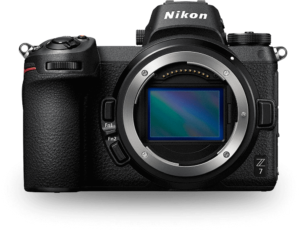
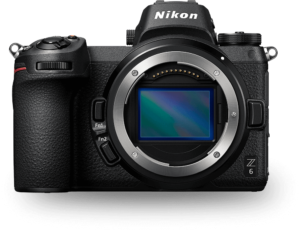
After months of teasing, Nikon has finally announced the details of their first-ever mirrorless camera launch.  The Nikon Z Series, with its first two models, the Z6 and Z7, represents the venerable company’s most ambitious new product launch in years.  Not surprisingly, the new full-frame Nikon models take aim squarely at Sony’s popular A7 III and A7R III models, with similar pricing and specs, respectively.  The Nikon Z6 will be priced at $1995.95 (body only) and the Z7 at $3399.95 (body only).  Initially only a 24-70mm f/4 “kit lens” and fast 35mm f/1.8 and 50mm f/1.8 prime lenses will be available, with more Z-mount lenses to launch in the future.  An adapter will also be available at additional cost to allow use of many existing F-mount lenses on the new Z Series bodies.

Details of the new cameras can be found on Nikon’s website: Nikon’s new mirrorless cameras.

While these new cameras offer very impressive technology and catch–and in many ways leapfrog–Sony’s mirrorless offerings, there are some disappointments specific to this Nikon launch as well as plenty of issues facing mirrorless cameras in general.

Regarding the shortfalls specific to the new Nikon Z6 and Z7, here are a few of my observations for how they fall short of my expectation:

  1. They lack a second memory card slot.  For pro shooters, this is a showstopper.
  2. The initial lens lineup will be very sparse, with only three lenses.  Over the next couple of years, Nikon will be rolling out additional lenses, but compared to the venerable F-mount glass lineup, the new Z-mount offerings will remain thin.
  3. The lens converter to enable use of existing F-mount lenses will have a considerable additional cost, won’t allow full auto focus and exposure on many existing lenses, and will likely cause the autofocus to perform slowly.

Mirrorless camera technology in general suffers relative to DSLR technology in substantial ways:

  1. They’re really not all that small and light relative to pro-level full-frame DSLR bodies.  And after the weight and bulk of the many lenses required by serious shooters are factored in, the mirrorless kit ends up almost as heavy and bulky as a comparable DSRL system.  A related issue is that many shooters find the smaller mirrorless bodies to be unbalanced when fitted with a heavy and large professional lens.
  2. The electronic viewfinders (EVF) on mirrorless cameras have evolved quite a bit in recent years, but they remain difficult to use, in my opinion.  They suffer from flicker and slow refresh rates, and they just don’t provide a realistic view of the scene.  It’s like looking at the world through a miniature TV screen vs. seeing it through your own eyes.
  3. Replacing not only our existing camera bodies but also all of our lenses to make a full move to native mirrorless technology is a very expensive prospect.
  4. With no mirror to protect the sensor, it’s very easy to get dust and dirt on the sensor when changing lenses.
  5. The Sony A-series suffers from poor usability (most functionality is relegated to sub-menus that are difficult to navigate) and from scant weather sealing that doesn’t meet the needs of most professional travel photographers.  I’ll have to get the new Nikon Z-series in my hands to assess whether Nikon has resolved these issues for their new offering.

With Nikon now joining Sony in the pro-level full-frame mirrorless game, and with Canon gearing up to announce its own mirrorless offering, there is increasing evidence that mirrorless technology represents the future of photography.  That said, as of today there are plenty of good reasons to continue using DSRL technology for its robustness, better viewfinders, much fuller lens lineups, and investment protection.  I’ll be much quicker to upgrade my Nikon D810 bodies by buying a pair of Nikon D850 bodies than by purchasing Nikon’s Z6 or Z7 bodies.  Your mileage may vary, and I’m eager to hear feedback from “To Travel Hopefully” readers.

Please share your thoughts about the new Nikon Z-series and about mirrorless vs. DSLR technology in general!

Want to read more posts about travel photography gear?  Find them all here: Posts about Gear.

Twenty Years of World-Class Hip Hop Dance [Encore Publication]: Capturing the groundbreaking SF International Hip Hop Dance Fest

I’m honored to be a photographer for the twentieth anniversary production of the world-class SF International Hip Hop Dance Fest.  If you think hip hop dance is just about b-boys and b-girls, this festival will broaden your horizons to the diverse array of hip hop, from jaw-dropping acrobatics to artistic and subtly activist choreography.

As a photographer specializing in travel and cultural documentation, I love having the opportunity to capture images from a wide range of nations and cultural styles, so each year I’m eager to shoot the diverse participants in this show who come from all over the world and represent many different faces of hip hop dance.

Today’s post consists of a photo essay of a few favorite performance images from this  year’s festival.  Note that all of the images appearing in this post and many more can be viewed and purchased in this gallery.

First, a few notes about the making of these images:

  1. During dress rehearsals the photographer is free to roam about the theater, often including the backstage area, apron and wings, and even onstage with the performers.  This mobility is not possible during live performances.  As a result, there are more creative possibilities during the rehearsals, so that’s when I seek out the most exciting and dramatic shooting concepts.  Unfortunately, this year I was traveling on assignment in Panama during the festival’s dress rehearsal dates, so I was able only to capture images from the live performances.
  2. When shooting fast-moving performances in very low light situations, I like to use mostly fast prime lenses coupled with a high ISO setting to allow a fast enough shutter speed to freeze the motion.  In the case of these particular performances, I also needed to use a long telephoto zoom lens due to being assigned seats quite far from the stage.
  3. Theatrical productions often use mixed temperature lighting that can be challenging for photography because of the strange and complicated color casts that often result.  Sometimes this can be fixed in post-processing, but often I choose to convert to monochrome to avoid unpleasant and unnatural color casts.
  4. The difference between adequate dance photography and excellent dance photography is all about the dramatic purpose.  I try to adapt my shooting and post-processing style to suit the dramatic intent of each moment during the show.

I hope you’ve enjoyed this sampling of images from the remarkable SF International Hip Hop Dance Fest.  It’s a challenge and a genuine joy to have the opportunity to make images of important large-scale dance productions such as this one.  Thank you for reading, and please share your thoughts and questions about today’s post here.

Note that all of the images appearing in this post and many more can be viewed and purchased in this gallery.

Focus on Panama [Encore Publication]: A man, a plan, a canal Panama, but so very much more


Iconic Panamanian scene: Nearly every visitor to Panama comes, at least in part, to see the canal, one of the wonders of the modern world.  Although our small vessel was able to transit the canal using the original 1914 lock system, we had the opportunity to visit the newly expanded 2016 lock system that can accommodate some of the world’s largest ships.  We observed this super container ship carrying more than 10,000 shipping containers each the size of a tractor-trailer truck as she transited the new lock system.  The massive scale of this scene makes it challenging to photograph.  Compose too tightly and you lose the grand sense of scale; compose too wide and you lose the dramatic impact.  I opted to capture this enormous vessel fully enclosed by the gargantuan lock chamber with the entrance to the Caribbean (Atlantic) waters and the modern Atlantic Bridge in the background.

My wife and I recently returned from a lovely two-week adventure traveling through Panama.  Our itinerary took us from the capital of Panama City to the historic and folkloric Azuero Peninsula, then up the Chagres River via dugout canoe for an in-depth encounter with the Embera indigenous people, followed by transiting the entire length of the Panama Canal aboard our 24-passenger catamaran, and ending with a visit to the remarkable rainforest of San Lorenzo National Park before returning to Panama City.  Throughout this adventure we had the opportunity to meet and learn about Panama’s people of diverse backgrounds and trades.  We discovered that Panama is much more than just a canal: it’s a photographer’s dream, filled with glorious landscapes, unparalleled biodiversity, centuries-old cultural traditions, and friendly people.

Our Panamanian adventure began in the largest city, Panama City.  While small relative to other major Latin American cities, Panama City is growing and thriving, juxtaposing a modern vibrant energy on top of a lovely historic Spanish-colonial old town.

Old meets new in Panama City as the Old Quarter ruins lie in the shadow of newer developments. To capture this juxtaposition of ancient against modern, I composed using a wide-angle lens and a low vantage point so that the skyline appears to grow suddenly from behind the ruins.  A narrow aperture (high f-stop number) allows both foreground and background to be in sharp focus.

Wildlife is abundant nearly everywhere in a rainforest climate zone, so our cameras should already be ready.  On the outskirts of Panama City, we observed this lovely iguana. I crouched down very low to shoot from the same level as the iguana, using a long telephoto set to a wide aperture (small f-stop number) to soften the background.  It’s important to shoot many frames of wildlife subjects to maximize the likelihood of capturing a few really strong shots.  This image appeals because the iguana appears to be smiling at us.

Lovely view over Panama City from the roof garden of our hotel.  A polarizing filter can help darken skies and enhance the sense of drama in clouds and water.  When composing busy images like this one, I seek a sense of harmony and balance between the different elements.  It’s also helpful to avoid the use of extremely wide-angle lenses and to keep the horizon level so as to minimize distortion of the vertical lines.

Food is an important aspect of travel, so it’s fun to make some images of the dishes we try, such as this whimsical presentation of ceviche in a local Panama City restaurant.  Photographing food in restaurant or home settings can be challenging due to poor lighting and cluttered backgrounds.  Here I removed some of the clutter from the table and shot from a 45-degree angle, which works well for many food presentations (shooting from directly above almost never flatters the dish).

A highlight of our stay in Panama City was getting to explore the neighborhood of El Chorrillo, nearly completely destroyed during the 1989 US invasion to oust Manuel Noriega.  Nearly three decades later, much of this neighborhood is still in shambles and its residents are divided on whether such destruction was justified.  I feel it’s a privilege to observe and photograph peoples’ homes during times of regeneration, so it’s important to explore and shoot photos with a high degree of respect for those who live in the neighborhood, speaking with residents and obtaining their permission before capturing images.

Departing Panama City for the historic and folkloric region of the Azuero Peninsula, we were very fortunate to arrive in the little town of Chitre on the day they celebrate Panama’s “First Cry of Independence”. The push for independence from Spain began here, then spread to the rest of the country.

Whether halfway around the world or right in my home town, I’m always thrilled to have the chance to capture the special energy and tradition of a festival or celebration.  Because festivals are very busy events, it’s important to look for clean backgrounds insofar as possible.  To make this portrait of two young Panamanians dressed in the national costume known as the pollera, I composed so as to minimize clutter in the background and also used a wide aperture (small f-stop number) to render the background in soft focus.  Too often photographers compose based only on the main subject, but a clean background is at least as important to the success of the image than an interesting foreground subject.

In the village of Las Tablas we visited a pollera-making workshop run by a husband and wife team. These intricately embroidered costumes can each cost tens of thousands of dollars and take years to make. The owners’ niece and son made adorable models for their work.  I asked them to move a few steps away from the cluttered area where they were standing so we could frame the portrait with the lovely traditional Panamanian window in the background.

Local fishermen ferried us from the mainland to the lovely Iguana Island for a day of snorkeling, hiking, and relaxing at the beach.  A strange sighting: this hermit crab re-purposed the discarded head of a child’s doll for its new shell.  I did not have a macro lens with me, so I used the closest focusing lens in my bag and got as close as possible, later cropping the image further during post-processing.

The second day of independence festivities are celebrated in the small town of Villa de los Santos. I asked this parade participant to pose for a portrait in a spot with a clean background and lovely soft lighting, then got in close with a fast prime portrait lens set to a wide aperture (small f-stop number) to throw the background out of focus.  Soft lighting (which can be obtained by shooting near sunrise or sunset, or by moving the subject into a shaded area) makes vivid colors truly pop and flatters the subject of your portrait.

The “First Cry of Independence” festivities last well into the night.  The extremely low-light conditions offer a photographer’s dilemma: either continue to shoot using only available light (and accept the added visual noise and motion blur) or switch to using flash (and live with its short coverage distance, artificial color cast, and distraction to the subjects).  I chose to work with just available light, boosting my camera’s ISO sensitivity setting to as high as I could get away with and using a fast prime lens at a very wide aperture to gather as much light as possible, which in turn allowed the use of a reasonably fast shutter speed.  The results are lovely: sharp dancers in the foreground with just a touch of motion blur, soft focus on the dancers and buildings in the background, and a soft and painterly feel for the scene that to me feels quintessentially Panamanian.

As we prepared to depart the Azuero Peninsula, we visited the mask-making workshop of renowned artisan Dario.  Even avid photographers enjoy returning home with at least a few photos of themselves and their loved ones, so I set up the camera and asked a fellow traveler to capture the shot.  Expect to spend some time fixing the composition and exposure in post-processing if your designated photographer is not very experienced.

After spending a few days on the Azuero Peninsula, we navigated up the Chagres River via dugout canoe to meet the Embera indigenous people.  This fascinating in-depth encounter offered a window into an ancient culture that has mostly disappeared from Central America as indigenous groups have been forced to resettle on national parklands where their traditional fishing and hunting practices are not permitted.  Our Embera hosts are able to continue to live in the traditional manner by sharing their culture with visitors like us.  Our lovely day spent with the Embera villagers included preparing and enjoying a traditional meal, visiting the two-room schoolhouse (supported by Grand Circle Foundation), exploring the village, learning about their government and way of life, and observing and participating in traditional singing and dancing.  We will never forget this experience.

We enjoyed a wonderful visit to the two-room schoolhouse in the Embera village.  As we shared songs and dances with the schoolkids, I made this portrait using only available light, intentionally blurring the girl’s hands to impart a sense of motion.

I got to know this Embera teen as she helped prepare her sisters and brother for the traditional dance ceremony.  We chatted and I captured photos of her preparations as she applied tattoos to her siblings using the juice of the jagua plant.  It’s always a good practice to get to know your subject before making a portrait.  Doing so will help put them at ease and allow you the opportunity to capture their true personality.  To make the portrait, I asked the girl to move outside of the hut to a spot with open shade and a pleasing background, then captured the moment using a fast portrait lens and a wide aperture (small f-stop number) to get that lovely “bokeh” (artistic quality in the out-of-focus background areas).

At the conclusion of our day in the Embera village, all the people of the village came out to demonstrate traditional singing and dancing for us.  For large group portraits, it’s often best to work with a slightly wide-angle lens, but not so wide as to cause distortion.  I chose a narrow aperture (high f-stop number) so that all of the people and the surrounding village landscape would be in sharp focus.  Shooting from the same level as your subject has the effect of seeming to place your viewer within the scene rather than (literally) looking down on the action.

A brief jaunt back to Panama City put us in position to board our 24-passenger catamaran, the M/S Discovery, for our three-day transit of the Panama Canal.

Strolling near our hotel, we happened upon these two brightly-colored toucans in a tree.  Using the longest telephoto lens at my disposal, I made the shot handheld with a fast shutter speed to minimize camera shake.  If your camera or lens has built-in image stabilization (also sometimes called vibration reduction), this modern feature can be very useful in avoiding blurring caused by camera shake.

Setting sail on the Panama Canal, we pass the Frank Gehry designed Biodiversity Museum with the Panama City skyline in the background.  Cityscapes can be great fun to photograph.  Attention should be paid to composing the image to include the most interesting urban features while eliminating extraneous and distracting elements.  A polarizing filter can help reduce reflection and enhance the color and texture of clouds and water.  And it’s always a good practice to keep the horizon line nice and level.

A spider monkey feeds in a tree on an island in Gatun Lake, highest point along the Panama Canal.  Photographing an animal in the low light of the rainforest canopy, and from a moving boat, is a challenge.  I boosted the camera’s ISO sensitivity setting and used the fastest aperture setting available on this lens to render a sharp image of the monkey in motion.

Transiting the Atlantic locks near the end of the Panama Canal.  This scene conveys the hustle and bustle of this hectic waterway without too many distracting elements.  I composed to include two relatively large ships in separate chambers of the locks along with the Canal Authority’s apparatus and our own ship’s Panamanian flag.

All of the images appearing in this post and many more are available for viewing and purchase on my website here: Panama photo gallery.

Have you traveled in Panama?  Please share the most memorable aspects of your photographic journey in the comments box.

Want to read more posts about world-class travel photography destinations?  Find them all here: Posts about destinations.

I See a Little Silhouetto of a Man [Encore Publication]: Intentionally underexposing your subject can create dramatic images

A silhouette is an image rendered as a solid shape of a single color with its edges showing the outline of the subject.  In photography this is a rather easy effect to achieve.  Simply by underexposing the subject by several stops, all the shadow detail is lost and the subject will appear as an outline in black.  This technique can yield dramatic, powerful images if used properly and sparingly.

When the subject is already backlit, just expose for the background and then dial down the exposure by approximately two stops.  This image of a man fishing off the seawall at the Malecon in Havana, Cuba works effectively as a silhouette.  The subject was strongly backlit by the late afternoon sun reflecting off the ocean, so I exposed for the water and compensated by another two stops.  The resulting photo is more evocative of the mood of quiet contemplation than it would be had I exposed for the fisherman.

This shot of a man fishing off a sea in Havana is rendered more powerfully with the subject in silhouette.  Buy this photo

During a studio shoot with a yoga and fitness model, we decided to try something different.  We turned off the main light and the fill light that ordinarily illuminate the model, and instead turned up the intensity of the lights on the white backdrop.  The resulting images showed the model in full silhouette as she dances and performs yoga poses.

In the studio, turning off the primary lights and increasing the brightness of the back lights yields a true silhouette.  This image is striking because it reduces the model’s form to an outline, emphasizing her motion.  Buy this photo

The silhouette is a simple technique you can use to get creative in your photography.  Experiment away–memory cards are cheap!

When do use the silhouette as a photographic technique?  Please share your tips here.

Want to see more posts on techniques?  Find them all here: Posts on Techniques.


Every Day I Write the Book [Encore Publication]: Even in the digital world, there’s a place for a hardcover photo book from your trip

In the brave new digital world, we have a lot of ways to share our travel photos after (and sometimes even before) we return from the trip: social media, on-screen slideshows, video montages, and of course the enduringly popular paper print.  Even with all of these very immediate sharing options, one of my favorite formats for preserving my travel images is the hardcopy photo book, and today there are more choices than ever before regarding how to create these wonderful keepsakes.

Our living room bookshelf and coffee table are home to more than a dozen photo books, each one showcasing the images and preserving the often fleeting memories of the details of a major trip we’ve taken.  Here’s why I love this method of sharing travel photography and how to create your own photo books.

img_3497

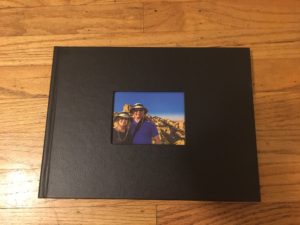
The leather cover of a photo book showcasing our recent travels in Turkey.

Why create a photo book?  Over time, new digital formats replace existing ones, and the very old ones become obsolete.  Within about 20 years, it is quite likely that none of our present formats of storing data will still be readable.  The printed page has much more staying power.  It is estimated that photos printed on high quality paper using high quality inks, and stored away from direct sunlight, can last for 100 years.  I’m a big fan of framed prints, as well, but a photo book is more cost-effective and space-efficient as a means to preserve many more photos than we could easily hang on our walls.  And because photo books can include customized captions to accompany the included images, they’re a great reference source for refreshing our memories about what we saw, when, and where.  Finally, photo books look great and are fun conversation-starters to tell the story of our travels when friends and family come to visit.

How do you create a photo book?  There are a number of methods, but unless you are a scrapbooker or handy with bookbinding, all of them involve sending your specifications and images to a vendor that will print the book, bind it, and mail it to you.  Some software packages, including Lightroom, have built-in modules for creating photo books.  And most photo sharing websites, including SmugMug (a fabulous site used by many professionals including me), Snapfish, Shutterfly, and Apple Photos, allow you to create and purchase photo books from your images.  These services vary in features, price, and quality, so shop carefully.  Most of my past photo books were created using Snapfish, but I am transitioning to using Lightroom’s and SmugMug’s services instead.  I will report on the results in a future post.

img_3493

Good book-creation software should allow you to choose from a wide range of formats on each page to display one or several photos plus text.

The basic process works similarly for any of these services.  You specify the book size, cover material, paper quality, printing quality, and other basic parameters for your book.  Then, you fill the pages of the book with your photos, specifying the layout you want for each page.  You can add captions for individual images or series of images, and you may be able to add various special effects.  At the end of the process, you place your order for the book to be printed and mailed to you.  Using the service offered by Blurb, which is available via SmugMug and Lightroom, you can self-publish a large or small print run of books and make them available for sale on Amazon or directly on your own website.

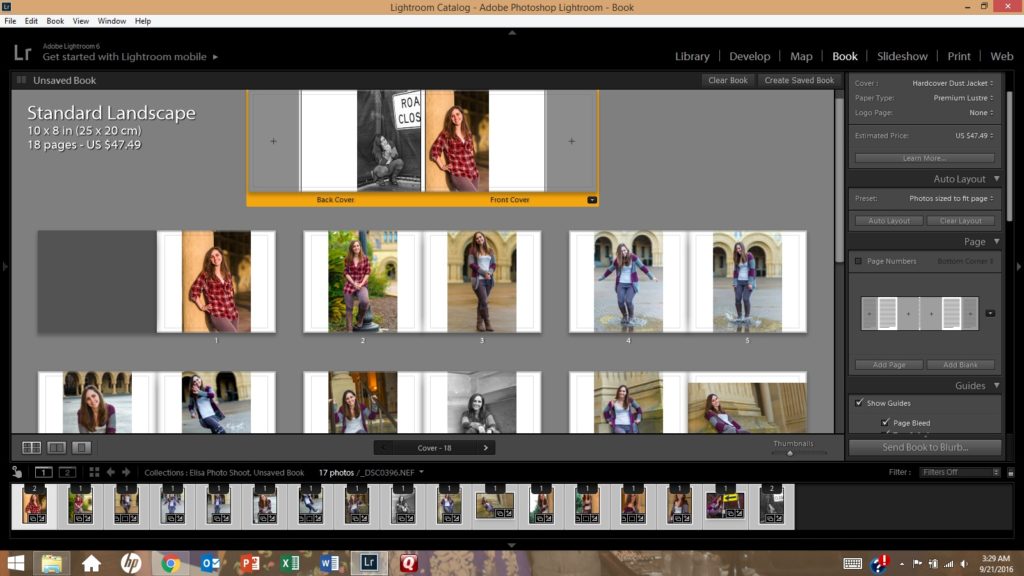
lightroom-book-moduleThe process of creating a photo book using Lightroom’s Book module (shown here) is fairly straightforward.  It’s even more intuitive using an online service such as Snapfish or Shutterfly.

When you receive your photo book a few days after placing your order, you’ll have a keepsake suitable for sharing with visitors and for preserving your own precious travel memories.

img_3494

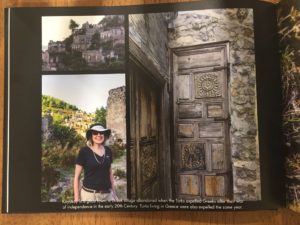
A two-page spread in our Turkey photo book showcases several images of the incredible rock formations in the Cappadocia region.

Have you created photo books from your travel images?  Which service did you use and how was your experience?  Please share your thoughts here.

Interested in reading more posts about sharing your travel images?  Click here to see them all: http://www.to-travel-hopefully.com/category/travel/share/.

Mardi Gras SF 2018 [Encore Publication]: A case study on shooting action in low light

San Francisco has been celebrating Carnaval for 40 years, and for the past 5 years I’ve been documenting this wonderful event.  The anniversary season officially kicked off last night with San Francisco’s take on Mardi Gras.  I covered the small parade through SF’s historic Mission District and also the performances of several comparsas (like krewes or samba schools) at one of the event’s venues.  Today’s post showcases some of my favorite images from this year’s Mardi Gras while also serving as a case study for shooting fast action in extremely low light conditions.

Taking the approach of “if you can’t beat them, join them,” remember that when shooting action in low light it is okay occasionally to intentionally allow some motion blur to emphasize the movement.  Here I achieved a soft painterly effect by choosing a slower shutter speed to capture this image of a young dancer mustering for the parade.

The use of flash is required for much low-light action photography, but that doesn’t mean your images have to be harsh or unnatural looking.  A few hints: 1) Get the flash off your camera using a flash cord or remote control; 2) Use balanced fill flash instead of automatic flash for a more realistic look; 3) Dial down the flash’s power by using flash exposure compensation (I use -1 stop most of the time); 4) These settings often will require that you use a high ISO setting and a fast lens.

Use a fast prime lens to achieve a fast shutter speed along with a relatively shallow aperture to freeze and isolate your subject.  Most of these images were made with a 50mm f/1.4 lens.

In post-processing your images, consider these tips: 1) Apply some noise reduction to mitigate the digital noise associated with high-ISO shooting; 2) Adjust the white balance to render the colors you remember from the shoot (always shoot in RAW mode if possible to allow setting the white balance during post-processing); 3) Apply a touch of post-crop vignetting to emphasize your subject and reduce background clutter.

For group shots, try to find an uncluttered background and pose everyone as tightly as possible so that your fill flash will illuminate them evenly.  Don’t use a wide-angle lens for group shots!  Sure, doing so will make it easier to fit in all the subjects, but it also provides a very unflattering perspective for most people.  Here I shot with a 50mm “normal” lens and moved back to fit in the entire group.

Portraits work very well using balanced fill-flash techniques.  Be sure to find an uncluttered background and get the flash unit off the camera.  Here I bounced the flash off the awning of a building to achieve a soft effect relatively unencumbered by shadows.

By applying some of these techniques, you can capture fast-moving action even under extremely low-light conditions and still achieve realistic looking and flattering results.

Do you have suggestions for shooting action in low light?  Please share your thoughts here.

Want to read more posts about photographic techniques?  Find them all here: Posts about techniques.  And remember that all the images featured in this post as well as thousands more are available for viewing or purchase on my website–just click on any photo to view it in more detail.

When You Get Back Home [Encore Publication]: An introduction to the essentials of postprocessing

You may want to share some of your favorite images with friends and family right out of the camera while you’re still traveling, and as long as you’re not sharing so broadly that potential thieves may be alerted to your absence from home, that’s a fine thing to do.  To enable immediate and easy sharing, you can choose the setting available on many cameras to shoot both RAW and JPG files; the JPG images will often look pretty decent for sharing when they come straight from the camera, and you still have your much more detailed image data saved in the RAW files.

But when you get home from your trip, it’s worth making the effort to catalog and post-process the RAW files of your favorite images so that they will look their very best and so you will be organized for finding them in the future.  I’ll cover how to organize your catalog of images in a later post, but for now let’s take a look at the essentials of post-processing.

There are many software applications available to perform these tasks, but I strongly encourage you to check out Adobe Lightroom.  I use this tool, and nearly all professional and enthusiast photographers I know also use it.  You can license it along with other Adobe software on a pay-per-month basis as part of Adobe’s Creative Cloud, but it can also be purchased with a perpetual license (i.e., you purchase the software once and can use it forever), which is how I acquired it.

Once you have Lightroom installed on your PC, it’s easy to import your images from your camera’s memory card or from your PC’s hard drive and to organize your catalog of images using the software’s Library module.  When your images are in your Lightroom catalog, the software allows you to perform all post-processing you desire using its Develop module.  After shooting the image, my second-favorite part of the digital photography process is enhancing the the image in the Develop module.  The software package even gets its name, Lightroom, as the new digital equivalent of the work we older photographers formerly had to do in the darkroom, such as dodging, burning, and cropping our film negatives to get the images looking their best.

As an example of how a little post-processing can dramatically enhance an image, let’s take a look at a night shot I made of Copenhagen’s Christiansborg Palace, the seat of the Danish Parliament.  Here’s the “Before” picture:


Lightroom’s Develop module

The beauty of Lightroom’s method is that it doesn’t actually change your original image files as you edit them.  Instead Lightroom saves a roadmap of the various edits you make and stores this list of adjustments along with a pointer to the original file.  This is called “non-destructive editing”, and it allows you to edit your images to your heart’s content without overwriting or changing the originals at all.  You can go back as many times as you want later to revisit your edits and change them again and again.

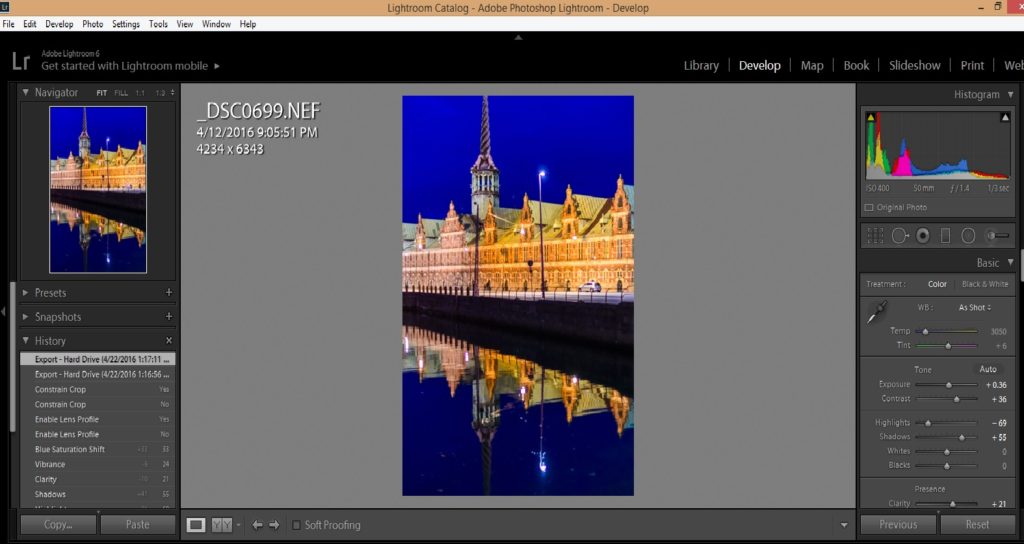
Let’s look at this process in more detail.  Here is the basic Lightroom Develop module screen:

lightroom develop module

The left bar shows a thumbnail of the image you’re working on and a list of the most recent edits you have made.  The central part of the screen shows a larger version of your image and this can be zoomed in and out to work on details or the whole image.  The right bar has a histogram (a graph showing how many pixels in the image are at each brightness level from totally black to totally white) at the top, then a toolbar from which you can choose some of the editing tools quickly, and then a large area with sliders (only some of which are shown in this screenshot) that you move left or right to adjust various elements of your image.  The editing tools in Lightroom are comprehensive enough that I find I very rarely need to import an image into Adobe Photoshop to make really sophisticated edits; nearly all of the time, I can perform all of my post-processing using only Lightroom.

Some photographers spend a lot of time making major enhancements to their images, but I like to try to adjust my camera’s settings precisely enough that the image is made in the camera the way I envisioned it when shooting, so that I need to make only minor adjustments in post-processing.  While the exact steps of post-processing will be different for every image, here is my basic workflow (note that for the most part, I work from the top to the bottom of the adjustment tools found in the right bar):

  1. Adjust the white balance as needed.  Remember my advice to always shoot in RAW mode.  One of the advantages of RAW files is that you can adjust the white balance in post-processing, regardless of what your camera’s white balance controls were set for while you were shooting the image.  In JPG files you have much less control over the white balance after the fact.  Just choose a different preset white balance type (such as Daylight, Shade, or Flash) from Lightroom’s menu, or create a custom white balance yourself.
  2. Adjust the exposure as needed.  Use the histogram and the image preview pane to lighten or darken the whole image until it looks best.
  3. Adjust the contrast as needed.  Increasing contrast gives more separation between the darkest and lightest portions of the image, while decreasing contrast does the opposite.  I find that most images require the contrast to be increased slightly to moderately.
  4. Adjust the highlights and shadows as needed.  Highlights are the brighter parts of the image, and I find that often these need to be reduced in brightness to regain some detail that may have been lost in the camera.  Shadows are the darker parts of the image, and often these need to be made brighter to bring out lost shadow detail.  After the highlights and shadows have been adjusted, you may need to adjust the whites and blacks (very brightest and very darkest points in your image) if there are extremes of contrast present.  Most of the time I do not need to change the white and black points.
  5. Adjust the clarity as needed.  The clarity slider changes the contrast of the middle tones (neither the darker nor the lighter parts) of the image.  Usually images need a subtle increase in clarity to bring out the details in the texture.  Don’t overuse this tool or the image can become unnatural looking.
  6. Adjust the vibrance and/or saturation as needed.  Both of these sliders will change the concentration of the colors in your image, but vibrance tries to avoid changing the color of skin tones so images with people will often look more natural after increasing the vibrance than after increasing saturation.  Occasionally you might need to make adjustments to both vibrance and saturation, but usually I find a subtle increase in vibrance is sufficient.  Again, don’t overuse these tools or your image will start to look exaggerated and surreal (unless you’re going for those effects).
  7. Adjust the concentration of individual colors as needed.  Each color channel has its own slider to increase or decrease its saturation.  I don’t use these sliders often, but occasionally you may want to increase or decrease the saturation of just a single color.  For example, when shooting a landscape with sky or water, you may want to increase the blue saturation to bring out those parts of the image.
  8. If you want to work on your image in black-and-white, the color channels area is the tool I use to do the conversion from color to monochrome.  Click on the “B&W” tab above the individual color channel sliders, and then adjust the mix of how the colors are blended by increasing or decreasing each color’s slider to see how the black-and-white image looks.  I find that I often have to readjust the contrast slider at this point to get the image looking its best in black-and-white.
  9. There is some sharpening already applied to your image file by default, but if it looks too soft in the important areas, you can dial in some additional sharpening.
  10. When the image you’re editing was shot at a high ISO (sensitivity) and/or a very long shutter speed, there will likely be some noise in the image.  This can be managed somewhat in Lightroom’s noise reduction tool.
  11. Under basic lens corrections I will usually select all three of the check box items.  Lightroom knows how most camera and lens combinations work and can eliminate many of the optical glitches that would otherwise show up in the image.  Under manual lens corrections, I may need to rotate the image if the horizon wasn’t level when it was shot.
  12. All of the above adjustments affect the entire image.  After completing these adjustments, it’s time to make any selective adjustments that affect only a selected part of the image.  These selective adjustment tools can be found in the toolbar just below the histogram.
  13. Of these selective adjustment tools, the most generally useful is the cropping tool, which of course allows you to remove unwanted portions of the image on the sides, top, or bottom.  It’s always best to try to compose the image correctly in the camera, but cropping is often still needed in post-processing.
  14. The spot removal, filters, and adjustment brush are more complicated selective adjustment tools that can easily be subjects of additional posts in their own right.

These steps usually won’t all be needed for any one image.  If you have several images that were shot under similar conditions, you can select them all in the Library module and turn on Auto Sync, which then allows you to make the adjustments only once and apply them to all the selected images.  Another big time saver is creating your own presets, which are saved routines that you can call at the click of a button to automate tasks that would otherwise have taken multiple steps.  Unlike Photoshop, Lightroom was designed by Adobe specifically for photographers to use, so it is set up in such a way as to make life much easier for us to organize, edit, and share our images.

Here is the “After” version of our sample image of Copenhagen by night.  You can see how a few simple edits during post-processing can really make an image pop.

Buy this photo

I hope you’ve found this very basic introduction to the essentials of post-processing to be helpful.  Now it’s your turn.  What are your go-to techniques in editing your images?  Do you have tips and tricks that you’ve found make your life easier after you return from a trip?  Please share your thoughts in the comment box at the end of this post.

Want to read more posts about post-processing your images?  Find them all here: Posts on Post-Processing.

Focus on Carnival in Madeira [Encore Publication]: This tiny Portuguese island group celebrates a vibrant and unique Mardi Gras

When we think about Mardi Gras carnivals, most often the first locations that come to mind are Rio de Janeiro, New Orleans, and perhaps Trinidad.  But the start of the Lenten season is celebrated in many parts of the world with the outpouring of dance, music, color, and joy known as Carnival.  While each region’s celebrations have a few elements in common–typically the all include grand parades with samba dancers and floats, all decorated in lavish costumes–there are many notable regional differences.  For example, in my home in the San Francisco Bay Area, Carnaval SF is unique for its array of “comparsas” (samba school contingents) representing the cultural traditions of all of Latin America and the Caribbean as well as parts of Asia.

This year I had the great pleasure of capturing Mardi Gras Carnival images on assignment in Funchal, capital of the tiny island group of Madeira.  While politically a part of Portugal, Madeira is located off the coast of Morocco in North Africa and has a decidedly different cultural flair than what is found in mainland Portugal.  Samba and Carnival were essentially invented by African slaves in Brazil while it was a Portuguese colony, and the samba parade traditions have migrated back to Portugal where celebrations are held throughout the country.  Given its location between Africa and Europe, Madeira combines distinct cultural traditions from both regions and offers a special flavor of Carnival that I found exhilarating.  And best of all, the celebrations roll on over a whole week with numerous events, retaining a true local flavor with few tourists.

Today’s post features some of my favorite images from this year’s Carnival events on Madeira.  If you’d like to see more photos, or to purchase a few, please visit https://www.kadlerphotography.com/Travel-Photography/Madeira-Carnival/.  I am grateful to the Madeira Promotion Bureau for their assistance providing access to the Carnival events.  Enjoy!

I hope you enjoyed these images from this year’s Carnival events on Madeira.  Visit https://www.kadlerphotography.com/Travel-Photography/Madeira-Carnival/ to see more photos.  Again, a big thank-you to the Madeira Promotion Bureau for their assistance providing access to the Carnival events.
Have you discovered any less known locations for Carnival celebrations?  Please share your experiences and your photos here!

The Berlin Chapter [Encore Publication]: Updates on my ongoing Human/Machine Dance Project

Last summer I began a passion project in collaboration with choreographer, dancer, and Fulbright Scholar Carly Lave with the goal of exploring how the human body moves and how we humans will be transformed by increasing immersion into advanced technologies, including virtual reality, robotics, and interconnectivity.  I was delighted when one of my images from this project was recognized by my being named one of three Emerging Pros in Digital Photo Pro Magazine’s biannual awards.  The image was the overall winner in this international competition’s “Fashion & Beauty” category.

In an earlier post I shared a few favorite images from the California-based photo shoots that Carly and I conducted last summer.  In today’s post I’ll share a few new images from our recent photo shoots conducted in Berlin, Germany, where Carly is spending the year as a Fulbright Scholar.

Der Temporaum in Berlin: Flug

“Der Temporaum in Berlin: Flug”.  Carly takes flight while exploring a virtual world. The very real world she inhabits here is a shared workspace for artists in a Soviet-era neighborhood of the former East Berlin.  To capture the fast action of Carly’s leap, I used a fast prime lens nearly wide open so as to achieve a fast shutter speed while shooting at a relatively low ISO.


Der Temporaum in Berlin: Tanzen

“Der Temporaum in Berlin: Tanzen”.  Carly dances within a shared workspace for artists in a Soviet-era neighborhood of the former East Berlin.  To create the soft, intimate feel of this portrait, I used a prime portrait lens (85mm) at a wide aperture (f/2.0) to allow the lovely light streaming through the window to illuminate Carly and to throw the background into soft focus.  Composition is very important to the success of intimate portraits, so I was careful to frame Carly’s body within the lines of the window casement and using the soft white curtains to provide a pleasing and non-distracting background.


Tempelhofer Feld I

“Tempelhofer Feld I”.  The virtual and physical worlds collide on a defunct runway at the pre-WWII airport of Tempelhofer, now a recreational space in the south of Berlin.  Working on location in outdoor settings can be tricky and success may be dependent on weather conditions and other factors.  Carly and I conducted this shoot during a gathering storm, making for a dramatic sky that complemented our theme and the industrial setting very nicely.  The accompanying challenges we experienced were very high winds, shifting light, and very little time to shoot before the sky opened up in a barrage of pelting rain and hail.  Fortunately we were able to “get our shot” before getting soaked to the bone.  I framed this image to give prominence not only to Carly but also to the old airfield’s runway and to the stormy sky.

Der Temporaum in Berlin: Schwarz und Weiß

“Der Temporaum in Berlin: Schwarz und Weiß”.  While I liked the way this image looked in color, my visual concept of the scene called for high-contrast black-and-white to give it an antique graphic-arts feel that seemed to suit the historically drab East Berlin setting.  During post-processing I converted the image to monochrome and increased the contrast, adjusting the tone and color curves until I achieved just the effect I was seeking.

Der Temporaum in Berlin: Virtuell

“Der Temporaum in Berlin: Virtuell”.  Carly explores a virtual world. The very real world she inhabits here is a shared workspace for artists in a Soviet-era neighborhood of the former East Berlin.  Using a fast prime lens at a very wide aperture setting, I intentionally limited the depth-of-field to such an extreme that Carly’s hands as well as the background were thrown into soft focus.  I like the effect this has on leading the viewer’s eye from the outstretched arms to Carly’s head and upper body, then around to the bleak industrial background.  The view thereby experiences some of the sense of exploration in the space where Carly is feeling her way.

Tempelhofer Feld II

“Tempelhofer Feld II”.  This image was made in a similar fashion to the previous one at the same location, except that here I gained a different perspective by backing further away from Carly as well as crouching down to the ground.  The resulting effect is one of precariousness rather than one of steadfastness in the earlier image.

I hope this behind-the-scenes peek at my ongoing passion project will help inspire your own creative process.  It’s important to be personally and deeply invested in a project before you begin.  Select your partner(s) carefully and plan thoroughly.  Then the process becomes joyful and exhilarating as you begin to bring your concept to life!

Have you carried out a photography project?  Please share your key learnings–positive and otherwise–here!

Want to read more posts about what to photography while traveling or near home?  Find them all here: Posts about What to Shoot.


Planning a Shoot [Encore Publication]: A case study in planning and executing a photo shoot

Whether traveling or near home, some of our best photo opportunities occur spontaneously.  Serendipity is part of the fun of photography, but another big part of the photographer’s craft is to carefully plan and professionally execute a photo shoot.  Using a recent shoot in which I collaborated with professional dancer Molly as a case study, in this post I’ll cover the essential elements of planning and conducting a shoot.

Good planning is key to ensuring a fun, safe, and efficient shoot as well as obtaining the desired artistic outcome.  Buy this photo

Elements to Consider When Planning a Shoot:

  • What is the theme or mood?  The artistic concept will inform all the other elements of the shoot.  For the shoot with Molly, we decided on an edgy, urban theme.  Based on that choice, the decisions about location, timing, gear, technique, and post-processing all flowed consistently.

We chose a gritty, urban theme for this shoot, and all other decisions flowed from that choice.  Buy this photo

  • Where is the location?  Often one of the most challenging aspects of planning a shoot is scouting for a suitable location.  The location, of course, should support the theme of the shoot.  It also needs to be accessible, safe (for this shoot, we rejected shooting on or near railroad tracks for safety reasons), and suitable for making the type of images desired.  There are also legal considerations, as in most cases permission is required to shoot on private property and even some public spaces require permission for commercial uses.  Molly and I eventually decided on using the old barracks at the decommissioned Presidio of San Francisco and the adjacent Crissy Field recreation area.  This space was accessible, relatively safe, provided a gritty and urban mood, and afforded sufficient working room for both dancer and photographer.
  • When should the shoot be scheduled?  Obviously, the date and time scheduled need to work for all parties involved.  These parties include not only the model(s) and photographer, but also other client(s) and often an assistant.  Equally important is ensuring the timing supports your artistic choices.  The season of the year and the time of day should offer the best chances of obtaining the lighting you desire.  The scheduled time should also work as well as possible with respect to other considerations such as opening hours of the chosen space, traffic and volume of other people in the location, and even tides, snowfall amounts, or other environmental factors.  Molly and I chose to shoot in the “golden hour” just before sunset on a Sunday to ensure good lighting and access to the location.
  • What gear and techniques should be used?  After choosing the theme and the supporting logistical elements, it’s time to select the techniques desired to capture the images and the gear required to execute.  Elements to consider include lighting (I prefer to work with available light and reflectors/diffusers whenever possible, but sometimes speedlights or portable studio lights are required), lenses (it’s often best to bring a range of lenses for different perspectives), props, and accessories (will you need to stabilize with a tripod, or perhaps you’ll require neutral density filters to obtain the shutter speed and/or aperture you want?).  In the shoot with Molly, I used the camera handheld at mostly fast shutter speeds and low camera angles with fast prime lenses to get that edgy look.

To capture the fast motion of the dancing and to support the urban theme, I worked handheld with fast prime lenses and low camera angles.  Buy this photo

  • How should the images be post-processed?  Again, the overall artistic concept should inform decisions about post-processing.  For this shoot, I aimed for a high-contrast, slightly grainy look and also converted several of the images to black-and-white.
  • How will the images be distributed and used?  All parties should agree before the shoot on how the images will be shared and/or sold.  To protect both model and photographer, it’s a good idea to sign a model release.  For more information on model releases, see this post: Post on Model Releases.

With attention to planning and execution, a photo shoot will be more enjoyable and productive and the artistic results will be better.  Buy this photo

Do you have tips and tricks you use when preparing for your shoots?  Please share your thoughts here.

Want to read more posts about planning your photography?  Find them all here: Posts on Planning.

Travel Photographers of the World, Unite!: Join my Meetup group

Dear Readers,

I have organized a new Meetup group, Travel Photography Workshops, as a forum to connect and learn in a variety of different ways. Whether through photo walks, hands-on workshops, classes, exhibitions, and photography tours to locations around the world, our goal will always be to fuel our passion for travel photography as we grow our skills. Please join us! Details at: http://meetu.ps/c/3Yl63/vbccL/f.

Love to explore the world through a lens? Do you strive to capture authentic images of the people and places you visit? Excited about using your camera to build bridges across diverse cultures? Want to continually improve your photography in all genres? Then this meetup is for you!

Travel photography is thrilling because it’s about discovery and adventure. Whether we’re halfway around the world or a few short blocks from our home, our camera is a tool to capture the spirit of the places we visit and to share that spirit with our community. The travel photographer must be versatile, switching effortlessly among many genres including landscape, wildlife, cityscape, portrait, performing arts, nighttime, and street photography. Share your passion for travel photography with other like-minded enthusiasts, and build your skills in a supportive community.

We’ll connect and learn in a variety of different ways. Whether through photo walks, hands-on workshops, classes, exhibitions, and photography tours to locations around the world, our goal will always be to fuel our passion for travel photography as we grow our skills. Please join us!

I Feel Like a Kid in a Candy Store [Encore Publication]: Capturing the spectacular SF Movement Arts Festival

Note: For the first time, this year there will be a summer version of the SF Movement Arts Festival! If you live in the SF Bay Area, please plan to attend this amazing event on July 19 at Grace Cathedral.

As an official photographer once again for this year’s SF Movement Arts Festival, last Friday I had the privilege and pleasure of capturing images of most of the more than 300 talented and diverse performers who participated in this year’s amazing event. If you live in the SF Bay Area and missed it, this year there will also be a summer version, presented in July.

This epic event of breathtaking beauty and scope brings together many of my favorite choreographers and dancers–those with whom I collaborate throughout the year, their younger students, and some who I’ve never met before–representing a tremendous range of movement practices and dance styles, and throws them all into the grand interior spaces of San Francisco’s iconic Grace Cathedral. My assignment, truly a labor of love, is to stay all day and all night: for the rehearsals, side photo shoots, and the performance, in an effort to capture images of nearly every performer in the festival. Truly, I feel like a kid in a candy store, having the opportunity to make images with so many amazing movement practitioners in this ethereal space, all in one day.

Today’s post, presented as a simple photo essay, shares some of my favorite images from this mind-boggling event. All I will add in the way of technical notes are a few points my regular readers will already know to expect from me:

  • When shooting fast-moving action in a relatively dark space, use as fast a lens as you can given your focal length needs, boost your camera’s ISO sensitivity setting to as high as you can get away with, and choose an aperture as wide as possible given the depth-of-field you seek
  • Choose a shutter speed that is fast enough to freeze the performers’ movement, unless you’re intending to create an artistic motion blur
  • Watch your backgrounds: what’s behind your main subject is as or more important than your subject itself, so try to choose a pleasing or less distracting background whenever possible, and keep your horizons level
  • Compose your images with an eye toward putting your viewer within the performance to experience the beauty, athleticism, and grace first-hand
  • Shoot lots of images because the performers’ body postures, gestures, and facial expressions will change in an instant and you want to be sure to capture a few frames that bring out their very best.

You can view and purchase all of the images in this post, and many more, by visiting my web gallery here: SFMAF Photo Gallery .

I hope you’ve enjoyed this small sampler of images from the incredible SF Movement Arts Festival. You can view and purchase all of these and many more by visiting my web gallery here: SFMAF Photo Gallery .

Do you have a favorite festival or cultural event that inspires and excites you so thoroughly that you feel you could photograph it every day? What are your go-to techniques for capturing images at these events? Please share your thoughts here!

Hiking in Southwestern Ireland [Encore Publication]: How to capture glorious landscapes along the trails

The central portion of our recent trip through Ireland and Scotland was a week of hiking in the southwest of Ireland.  While we hiked independently, the logistics were arranged for us by a travel company called Country Walkers (http://www.countrywalkers.com/).  With its richly verdant and rugged terrain, glorious views to the sea and mountains, historic and cultural points of interest, and warm and welcoming people, this region is supremely rewarding for the travel photographer.

I highly recommend a visit to the very remote Gougane Barra peninsula.  There’s only one hotel, which offers outstanding food and views over a tiny island with a picturesque church and the ruins of a sixth century monastery.  A photographer’s paradise!

St. Finbarr’s Church stands on a tiny island on the Gougane Barra Peninsula.  To make this image, I shot in the early morning when the quality of light was compelling, got down low to include the rushes in the lake, and used a polarizing filter to bring out the textures in the water and sky.  Buy this photo

Don’t put away your gear when the sun sets!  On a rare clear night in rural Ireland, the photography is stunning.  Here’s an image of the Milky Way sprawling above the ruins of St. Finbarr’s Abbey, a sixth century monastery.

To capture the Milky Way, use a sturdy tripod and a relatively fast lens with a high ISO setting.  In most cases, a shutter speed of 20-25 seconds is best, but here I used a somewhat shorter exposure to avoid having the cross appear washed out in the site’s artificial light.  Buy this photo

We then hiked a segment of the long-distance Sheep’s Head Way.  You’ll rarely encounter completely clear skies while walking in Ireland, but the changeable conditions can create opportunities for glorious landscapes.  This lovely image was made just as the rain let up and the sun poked out, generating a vivid rainbow that spanned over the green fields and ancient walls.

Here I used my go-to landscape lens, the Nikon 16-35mm f/4 lens, fitted with a good circular polarizing filter.  I adjusted the angle of the polarizer carefully to enhance the sky without weakening the refraction of the rainbow.  I got down low to the ground to include the leading line from the old wall.  Other compositional elements include the sheep and the dramatic clouds.  Buy this photo

Ladder stiles are encountered frequently when hiking in this region, but are less familiar back home, so dramatic images can be made incorporating travel companions crossing fences using these ladders.  Here I used a wide-angle lens with polarizing filter to emphasize the expansive terrain and dramatic sky.  Buy this photo

At the end of the Sheep’s Head Way sits the lovely Bantry House, owned by the same family since 1750.  Climb the hill behind the house to capture the house and its gardens with the harbor behind.  Buy this photo

On our way to the start of our next day’s hike in Killarney National Park, we stopped at a viewpoint called Priest’s Leap for this lovely view.  I’ve said it before and I’ll say it again: remember to include yourself and your travel companions in some of your images.  Set up the camera and either mount it on a tripod or show another person how to release the shutter.  For more on how to make images including yourself, read this post: Post on Including Yourself

This image at Priest’s Leap was made using a normal lens with polarizing filter, stopped down to maximize depth-of-field.  Buy this photo

Ireland is filled with forests that are shrouded in mystery and magic.  Look for the little things as you walk: a flower or shamrock, a moss-covered tree, a tiny stream.  All that rain has the happy side-effect of making Ireland the greenest place I’ve ever seen.

Slow down and seek out the little natural details around you, like this moss-covered tree in Killarney National Park.  Buy this photo

The lovely Torc Waterfall within Killarney National Park is one of the most scenic in the region.  To capture the motion of the water, I used a neutral density filter to allow a long shutter speed and steadied the camera on a solid tripod.  Buy this photo

The legendary Gap of Dunloe outside of Killarney stretches for eight miles through mountains and valleys, along streams and by ancient farmhouses.  It can be traversed by horse-drawn carriages called “jaunting cars,” but the intrepid photographer will want to hike it instead.

The Gap of Dunloe offers compelling photographic subjects like this stream flowing in a valley surrounded by mountains.  A good wide-angle lens with a polarizing filter brings out the color and texture in such a landscape, even on a “soft day” like this one.  Buy this photo

Hiking isn’t the only great way to see the local landscapes.  After hiking the Gap of Dunloe, take a boat ride along the rivers and lakes to the ancient Ross Castle.

This mountain rising from the lake was captured during the boat ride back from the Gap hike, using a normal lens with polarizing filter.  Buy this photo

We spent every evening in Ireland visiting a pub or two.  These pubs differ in character, but all reflect the generous and friendly local culture, and many offer live music.

At a pub in Killarney, I was chatting with this fiddler during a break between sets and made this portrait using natural light with a fast portrait lens, a wide aperture, and a high ISO.  Buy this photo

My essential portrait lens:

We were fortunate to stay two nights in Killarney at the wonderful Lake Hotel.  The hotel grounds include the ruins of an ancient castle situated on a lake with mountains behind.  During breakfast on our second morning, I noticed the cloud cover had lifted but there was still mist hanging on the side of the hills around the lake.  I ran up to our room, grabbed my thirty pounds of camera gear, and rushed outside to capture the ruins with the mist enshrouding the lake and mountains.

There was no time to set up a tripod as the warming sun was burning away the magical mist on the lake, so I shot this image handheld.  Buy this photo

Our final day’s hike was the beautiful Wild Atlantic Way from Ventry to Dunquin.  The lovely views of the Atlantic are punctuated with green fields dotted with odd “beehive huts,” some dating back to the Neolithic Period.
To make this landscape incorporating ancient stone beehive huts and walls, I shot down across the fields to the sea, being sure to keep the horizon level.  Buy this photo

The picturesque Blasket Islands were home to a community of Irish-speaking farmer-fishermen until they were forced to evacuate in 1953.  This is one of Ireland’s most gorgeous stretches of coastline, captured here using a wide-angle lens with polarizer.  Rotate the filter until the sky is dark and dramatic.  Buy this photo

I hope this post inspires you to hike and photograph in this gorgeous region.  Expect some wet weather nearly every day, and prepare accordingly to protect yourself and your camera gear.  You’ll be richly rewarded with expansive views of some of the world’s greenest and loveliest vistas!

Have you visited southwestern Ireland?  What were your most memorable experiences?  Please share your thoughts here.

Want to see posts on other travel photography destinations?  Find them all here: Posts on Destinations.

Focus on the Embera People [Encore Publication]: Capturing enchanting images of an ancient traditional way of life

During our recent travels in Panama, my wife and I navigated up the Chagres River via dugout canoe to meet the Embera indigenous people.  This fascinating in-depth encounter offered a window into an ancient culture that has mostly disappeared from Central America as indigenous groups have been forced to resettle on national parklands where their traditional fishing and hunting practices are not permitted.  Our Embera hosts are able to continue to live in the traditional manner by sharing their culture with visitors like us.  Our lovely day spent with the Embera villagers included preparing and enjoying a traditional meal, visiting the two-room schoolhouse (supported by Grand Circle Foundation), exploring the village, learning about their government and way of life, and observing and participating in traditional singing and dancing.  We will never forget this experience.  In the spirit of sharing, today’s post is a photo essay featuring images from this special day.  Click on any of the images to visit the Panama photo gallery on my website, where many more photos are available to view or possibly to purchase.

Traveling up the Chagres River via dugout canoe to meet the Embera indigenous people. 

This lovely Embera mom and daughter greet us on arrival at their village.

The Embera people lead us up the hill from the river to their village.

To make this portrait of a young Embera woman, I asked her to move a few feet to an area with pleasant lighting and an uncluttered background, then shot using a fast prime portrait lens (85mm f/1.8) at a wide aperture to throw the background into soft focus.  

Showing us how the midday meal is prepared. 

We enjoyed a wonderful visit to the two-room schoolhouse in the Embera village.  As we shared songs and dances with the schoolkids, I made this portrait using only available light, intentionally blurring the girl’s hands to impart a sense of motion.

One of our group brought along simple dolls to hand out to the Embera children.  Group portraits can be tricky in general, but are very challenging when the subjects are young children.  My advice is to capture plenty of shots over a period of several minutes, interacting with the kids all the while.  This allows the children to relax around the photographer, and maximizes the likelihood of getting a few really good images.

I’m never happier than when I can experience and photography traditional cultural performances (singing, dancing, theater, puppetry, etc.).  Our new Embera friends were kind enough to show us some of their tradition of song and dance.  I find that the preparations for these performances are often as or more fascinating than the performances themselves.  Here, a young boy practices his drumming for the upcoming show.

In preparation for the singing and dancing performance, this Embera teen prepares her younger brother and sister by applying tattoos using the juice of the jagua plant.   

I got to know this Embera teen as she helped prepare her sisters and brother for the traditional dance ceremony.  We chatted and I captured photos of her preparations as she applied tattoos to her siblings using the juice of the jagua plant.  It’s always a good practice to get to know your subject before making a portrait.  Doing so will help put them at ease and allow you the opportunity to capture their true personality.  To make the portrait, I asked the girl to move outside of the hut to a spot with open shade and a pleasing background, then captured the moment using a fast portrait lens and a wide aperture (small f-stop number) to get that lovely “bokeh” (artistic quality in the out-of-focus background areas).

This little one is all tuckered out even before the dance celebration begins.  To make portraits more intimate and personal, try to isolate the subject using narrow depth-of-field and a simple, non-distracting background. 

An impromptu soccer match in the green open area of the village. 

View of the Embera village from the top of a nearby hill.   

An Embera family pose for a portrait. 

At the conclusion of our day in the Embera village, all the people of the village came out to demonstrate traditional singing and dancing for us.  For large group portraits, it’s often best to work with a slightly wide-angle lens, but not so wide as to cause distortion.  I chose a narrow aperture (high f-stop number) so that all of the people and the surrounding village landscape would be in sharp focus.  Shooting from the same level as your subject has the effect of seeming to place your viewer within the scene rather than (literally) looking down on the action.

I hope you’ve enjoyed this photographic tour of our day spent with the Embera people in their small village located far up the Chagres River from Panama’s main city.

Do you have a memorable experience of meeting a group of people willing to share their traditional culture?  Please share your experience by leaving a comment here!

Want to read more posts about what to shoot while traveling?  Find them all here: Posts about what to shoot.

Focus on Lisbon, Berlin, and Barcelona [Encore Publication]: History, architecture, and cultures yield boundless photographic opportunities

My wife and I recently returned from two weeks of travel in Europe to fulfill several of my photography assignments. I’ll publish separate posts in the coming weeks covering some of those professional assignments. In today’s post we’ll explore the vibrant capital cities of Lisbon, Berlin, and Barcelona. While each of these three cities has a personality very much its own, I’m hoping my images will demonstrate that photographing cities, like photographing people, is all about looking for what we have in common even as we celebrate our differences. Urban photography is special to me because cities are the places where history, architecture, and culture often align most dramatically to paint a full picture of how we live today. Note that all of these images and many more are available to view and, if desired, to purchase; just click on any image to view the gallery. Enjoy!

On arrival in Lisbon, we are treated to an early morning view of the old Moorish quarter of Alfama. I like to underexpose by 1-2 stops when shooting sunrises and sunsets to bring out more intensity in the colors. If in doubt, bracket your exposures and choose the one that best captures the scene as you experienced it, or combine the different exposures into a composite high dynamic range (HDR) image.
I loved the look and feel of the old streetcars plying the streets of Lisbon, so I found this picturesque spot and waited until the next tram came into view.
If you had told me one of the most amazing experiences in Lisbon is visiting a tile museum, I’d have answered it’s more exciting to watch the grass grow. But it turns out the National Azulejo (Tile) Museum is absolutely incredible from start to finish. This ornate chapel, decorated in azulejo tiles, is entirely contained within a part of the museum. When shooting interiors it is often advantageous to use a wide-angle lens, but it’s important to keep the camera level to the plane of the ground and avoid shooting upward or downward in order to avoid the severe proportional distortion that can occur in these situations. While it is possible to correct for this sort of distortion in post-processing software like Lightroom, it is preferable to get it right in-camera.
A nighttime street scene in Lisbon’s old Moorish neighborhood of Alfama. When handholding the camera in a low-light situation, especially when a small aperture is required for depth-of-field, it’s a good idea to boost the camera’s ISO sensitivity setting in order to achieve a relatively fast shutter speed.
We spent a full day exploring the Sintra region about an hour west of Lisbon, at the very far western edge of the European continent. Quinta da Regaleira is a wonderfully eccentric estate including a palace, a chapel, and several strange features adorned with symbols of alchemy, Masonry, the Knights Templar, and the Rosicrucians. Our favorite feature was this stone tower. I’m always on the lookout for repeating geometric patterns that often make for compelling images. It’s important to compose such shots carefully to enhance the power of the recurring pattern. I converted this image to black-and-white during postprocessing to give it a high-contrast graphic arts style look.

The Alfama neighborhood is famous as the birthplace of fado, a form of music typically performed by a solo singer accompanied by two Portuguese guitars. Fado is essentially a Portuguese version of the blues, with lyrics and melodies emphasizing the melancholy side of the culture. Most fado clubs feature extremely dim lighting to set the mood, and flash photography is strictly prohibited. This results in a technical challenge trying to capture good images. Here I used a very fast (f/1.4) prime lens almost all the way open and also boosted my camera’s ISO sensitivity setting to 6400 (as high as I like to go in order to avoid excessive digital noise), but still the required shutter speed was a rather slow 1/15 second. Instead of trying to capture the moving singer in tack-sharp fashion, I leaned into the mood of the place and allowed some motion blur to occur.
On our final day in Lisbon we explored Belem, an historic Medieval parish most well known for its medieval tower. Again, when shooting architecture with a wide-angle lens, try to shoot with the camera parallel to the ground to avoid distortion of the vertical lines. I also underexposed this image a bit to make for a more dramatic sky, recovering some of the shadow detail in post-processing.
Enjoying the Lisbon obsession, the sublime custard pastry known as Pastel de Belém, at the cafe that invented them (well, the recipe was probably borrowed from the Jerónimos Monastery next door). Food is a key part of any people’s culture, so I like to capture food scenes as part of every urban shoot. Insofar as possible, I try to arrange the various elements on the table so they tell a story in the frame of the image. Here I removed some of the items that cluttered the background, including just the pastries and the local coffee drinks. I try not to shoot straight down onto the food, as that usually results in unappealing shots. With food photography, some work is usually required in post-processing to adjust color temperatures and remove distractions like dirt and shadows.
After our stay in Lisbon, we enjoyed an unforgettable two days on assignment shooting the annual Mardi Gras Carnival festivities on the Poruguese owned island of Madeira. Those images will be featured in a separate post. Then, onward to Berlin. Our hotel was right next to the infamous Checkpoint Charlie section of the old Berlin Wall, shown here.
No visit to Berlin would be complete without passing through the stately neoclassical Brandenburg Gate. It can be very challenging to get a clean shot of very crowded iconic urban sites. Here I fitted a wide-angle lens, composed the shot looking straight toward the gate without pointing the camera up or down, and waited until nearly all of the tourists had left the frame. Some straightening of the vertical and horizontal lines still had to be done in post-processing to avoid the perspective distortion introduced by the very wide focal length.
Berlin’s Holocaust Memorial takes up a large city block and requires some time to take in and explore. To capture this large, powerful, and rather imposing monument, I composed using a moderately wide lens stopped down to a small aperture for maximum depth-of-field and keeping the horizon line with the background buildings completely straight. I converted to black-and-white in post-processing to achieve a stately, somber feel.
On our way home from Berlin, we had an overnight layover in Barcelona. With time in town for only one dinner and a bit of nighttime and morning sightseeing, we enjoyed Catalonian tapas for an authentic local dining experience. I arranged the stuffed pasta and wine glass in a pleasing pattern against the simple background of the wooden table and cropped the image to emphasize the food and wine without distractions. The color temperature usually needs to be adjusted during post-processing to give the food and beverage a realistic color.
Exploring Gaudí’s masterpiece, the cathedral known as La Sagrada Familia, at night. When shooting really iconic sites, I like to seek out unusual perspectives to avoid the dreaded “postcard shot”. Here I composed looking up from near the base of one of the towers, allowing the background to be filled by the dark night sky. This composition cleaned up most of the busy urban scene’s clutter and made for a dramatic capture of the basilica bathed in several types of light.
We had only 90 minutes to visit the interior of La Sagrada Familia before heading to Barcelona’s airport to fly home to San Francisco. I shot this self-portrait (Mary is also included) using a mirror positioned so visitors could view the soaring interior space of La Sagrada Familia.

I hope you enjoyed these favorite images from three great European cities, along with my descriptions of how the images were made. To view more images, or perhaps to purchase a few, just click on any of the photos to go to the gallery.

What are your favorite techniques or images from your urban photography? Do you have urban themes you like to document wherever you travel? Please leave a comment and share your thoughts.

Want to read more posts about travel photography destinations? Find them all here: http://www.to-travel-hopefully.com/category/destinations/.

Faces of Myanmar [Encore Publication], Part II: Showcasing the Diversity of Burma’s People

My wife and I recently returned from an amazing 2.5-week adventure traveling through Myanmar.  Our itinerary took us from the main city of Yangon to the vast plains gleaming with ancient pagodas in Bagan; then to the former imperial capital and cultural hub of Mandalay; on to Kalaw, the gateway to many hill tribes of the region; and finally to Inle Lake, well known for its picturesque floating gardens and for the Inthe people with their unique traditional style of fishing.  While it was wonderful to view Myanmar’s gorgeous landscapes and fabled temples, what made this adventure truly unforgettable for us was its many opportunities to interact with Burmese people from many ethnic groups and all walks of life: Buddhist monks and nuns, villagers displaced by a typhoon 10 years ago who are still living in temporary bamboo huts with no running water, the Paduang hill tribe whose women traditionally wear heavy brass plates on their necks, an octogenarian master of the dying art form of Burmese marionette theater, young boys celebrating their initiation as novice monks, and the delightful girls who have found a caring home at an orphanage in Mandalay.  Burma is a photographer’s dream, filled with glorious pagodas, gorgeous vistas, and friendly, diverse cultures.

Yesterday’s and today’s posts showcase some of my favorite portraits, some of them not yet previously published, featuring a wide range of people we met during our adventure.  The portraits will be presented as a photo essay, but I will include brief descriptions of each and occasionally some commentary about how they were made.  You can click on any of these images to view or purchase them and many more from the Myanmar trip.  Yesterday’s post featured Part I, and today’s post comprises Part II.

A fascinating visit to Myawaddy Nunnery, where we had the opportunity to meet some of the more than 200 novice nuns who study there.  I composed this image to include the contrasting colors of the novices’ pink robes against the painted carved teak facade of the building.

Portrait of the abbess at Myawaddy Nunnery.  The lovely “bokeh”, or soft quality of the out-of-focus background elements, is created by using a very wide aperture on a lens known for having this property (in this case, an 85mm f/1.8 prime lens).  Even when traveling, it’s important to have the right lens for the right job.

The Mingun Bell, 13 feet high and weighing 90 tons, is the world’s second largest functioning bell.

A delightful visit to the Aye Yeik Mon Girls’ Orphanage. We were heartbroken to learn the stories of some of the abandoned girls who live here, but were uplifted to see the wonderful care and guidance they are receiving there now.

I had the opportunity to get to know 15-year-old Phyu Phyu at the Aye Yeik Mon Girls’ Orphanage. Abandoned by her mother at an early age, Phyu Phyu’s early life was challenging, but she has flourished under the care of the nuns at Aye Yeik Mon and is planning to continue her education and to enter a professional career.

We were invited into the Mandalay home of Oma and his family. His mother was a restaurant owner and chef for many years, so we were treated to an amazing Burmese meal.  It can be challenging to make portraits of groups, especially when young children are involved.  I shot several frames and chose one where the young boys are looking (nearly) directly at the lens, settling for some of the other family members to be looking elsewhere.

Kuthodaw Paya is called the world’s largest book because the entire canon of early Buddhist scripture is recorded on carved stone tablets housed in its hundreds of pagodas.  These young local women wanted me to pose for a selfie with them, so I asked them to return the favor.  Their brightly colored longyis (traditional Burmese attire) stand out nicely against the drab background of the pagoda behind them.

A quiet moment at the entrance to Shwenandaw Kyaung Monastery.  I used spot-metering based on the woman’s clothing so as to achieve proper exposure given the much brighter background.

A stop at the Kalaw morning market to purchase the produce for our visit to Myin Ma Htie village.

We visited the village monastery in Myin Ma Htie and met with the monk there.

On arrival at Myin Ma Htie, we are greeted by villagers who will be our hosts.  This portrait was carefully composed to provide nice soft natural lighting on the girl and to frame her in a pleasing way within the surrounding area.

Traditional spinning methods to create yarn from lotus plant fiber.  I was struck by the symmetry and the bright color of the yarn in this scene.  

A worker in a cheroot workshop demonstrates her craft. She makes about 1000 of these small and inexpensive cigars every day.  To make this portrait, I used my go-to 85mm portrait lens at a wide aperture and added just a small amount of balanced fill flash to evenly expose the subject’s face.

The Phaung Daw Oo Paya is one of Burma’s most sacred sites. Dating to the 11th century, this pagoda houses the four remaining Buddha statues that enclose relics from the body of the Buddha. Worshipers add a little gold leaf to these statues when they visit, so that today the shape cannot even be recognized as that of the Buddha.

A fisherman on Inle Lake demonstrates the ancient style of fishing with a netted basket.  I framed the shot through the fabric of the net to add texture and visual interest.

Meeting members of the Padaung ethnic minority, whose women are famous for wearing heavy brass coils to make their necks look longer.  This 18-year-old Padaung girl proudly wears the brass coils on her neck as a symbol of ethnic identity. She told us her younger sister chooses not to wear the ornaments as she goes to a Burman school where most of the other students are not Padaung. The tradition was often scorned as backwards during the military regime, but now young Padaung women are again often choosing to practice it.

Have you visited Myanmar?  What were your favorite photographic subjects?  Please leave your thoughts here.

Want to read more posts about what to shoot while traveling?  Find them all here: Posts about what to shoot.

All of these photos and many more from Myanmar are available for viewing or purchase here: Myanmar image gallery.

Missed Part I of this story in yesterday’s post?  You can read it here: Part I of this story.

Faces of Myanmar, Part I [Encore Publication]: Showcasing the Diversity of Burma’s People

My wife and I recently returned from an amazing 2.5-week adventure traveling through Myanmar.  Our itinerary took us from the main city of Yangon to the vast plains gleaming with ancient pagodas in Bagan; then to the former imperial capital and cultural hub of Mandalay; on to Kalaw, the gateway to many hill tribes of the region; and finally to Inle Lake, well known for its picturesque floating gardens and for the Inthe people with their unique traditional style of fishing.  While it was wonderful to view Myanmar’s gorgeous landscapes and fabled temples, what made this adventure truly unforgettable for us was its many opportunities to interact with Burmese people from many ethnic groups and all walks of life: Buddhist monks and nuns, villagers displaced by a typhoon 10 years ago who are still living in temporary bamboo huts with no running water, the Paduang hill tribe whose women traditionally wear heavy brass plates on their necks, an octogenarian master of the dying art form of Burmese marionette theater, young boys celebrating their initiation as novice monks, and the delightful girls who have found a caring home at an orphanage in Mandalay.  Burma is a photographer’s dream, filled with glorious pagodas, gorgeous vistas, and friendly, diverse cultures.

Today’s and tomorrow’s posts showcase some of my favorite portraits, some of them not yet previously published, featuring a wide range of people we met during our adventure.  The portraits will be presented as a photo essay, but I will include brief descriptions of each and occasionally some commentary about how they were made.  You can click on any of these images to view or purchase them and many more from the Myanmar trip.

Here is Part I, and tomorrow’s post will feature Part II.

A worshiper at Chaukhtatgyi Pagoda. I’m always on the lookout for ways to include local people when shooting monuments and other landmarks.  The human element adds great visual interest to travel images and also personalizes the photo, transforming a generic scene into a story.

We were shown around the Musmeah Yeshua Synagogue by one of the 17 remaining members of Myanmar’s only Jewish community.  Environmental portraits like this one include not only the person but also some other elements that help tell the person’s story, in this case the Torahs at the ark of the synagogue.

A worshiper at Shwedagon Pagoda, the most sacred Buddhist site in all of Burma.  At least 90% of the time I include people as a main element in my images, I obtain permission from them first.  I find that this approach, as well as being friendlier than shooting first and asking questions later, tends to lead to better portraits as there is an interpersonal connection between the subject and the photographer.  However, there are certain instances when asking first could interrupt the subject’s activities or negatively impact the dynamic being captured.  For this photo, I made no attempt to hide that I was shooting the woman, but I didn’t interrupt her meditation, either.

Armies of volunteer sweepers make the rounds at Shwedagon Pagoda to ensure the temple is kept spotless.  To shoot this large and fast-moving group, I positioned myself at a scenic spot, configured my camera’s setting in advance, then waited for the volunteers to move into position.

Rangoon’s Inya Lake, site of the former military junta’s brutal response to the 8888 uprisings and the Saffron Revolution, is now a peaceful place where young people picnic, make music, and go on dates.  When shooting strongly backlit subjects, be sure to use spot metering or exposure compensation unless you’re trying to create a silhouette.  

Street vendor in Yangon.

A fascinating visit to an informal housing settlement inhabited by people displaced by the devastating 2008 typhoon. A decade later they are still living in squalid conditions in bamboo huts with no running water. Here, children are filling containers with water from the lake and carrying 40 kg (88 pounds) of water, often more than their body weight, several miles to their families’ homes. This image is a favorite because it effectively combines the contrasting moods of the scenic beauty of the region with the hardship of the people living there.

As curious about me as I am about her, a young dweller in the informal settlement comes to say “mingalaba”.  I used a fairly narrow aperture to create enough depth-of-field allow some of the background to be emphasized in addition to the girl.

A traditional Burmese dance performance showcases the dancers’ grace and the beauty of their costumes.  Always look for an uncluttered background when composing and be sure to capture multiple shots so that one will be timed just right.

At the village market in Nyaung-U in the Bagan region.  I introduced myself to the vendor and received permission to make her portrait. At first she appeared stilted and posed, but as she tended to other customers and got accustomed to my being there, she returned to a natural state.

Escaping steam nearly obscures a worker at a Bagan workshop where pone ye gyi (a popular flavored soybean sauce) is made.  A portrait can become much more visually interesting when composed in an unexpected fashion.

The matriarch shows us around her family’s paper workshop where they make ceremonial fans for weddings and other events.  I made this image using my classic portrait technique: using a fast portrait lens (85mm f/1.8) nearly wide open to emphasize the subject, and choosing a location with nice soft lighting and as uncluttered a background as possible.

One of the family’s daughters kindly poses for a portrait. She wears thanaka, the tree bark paste that most Burmese women, and quite a few men, apply to their faces daily.

We had been invited by villagers to attend a Buddhist initiation ceremony, so we rose early and traveled to their village. The boys in the back row are preparing to start their service as novice monks in a monastery. All Buddhist boys in Myanmar are required to perform this service at some point during their childhood.  The girls in the front row are some of their sisters who are celebrating their ritual ear piercing.

The boys paraded through the village to the monastery on horseback, while the girls and some of the parents rode oxcarts.  Another classic portrait using a fast prime lens at a wide aperture to soften the background, this image also was made with a touch of balanced fill-in flash to reduce shadows on the subject’s face.

During an excursion to Phaw Saw Village outside Bagan, we met this artisan.


Have you visited Myanmar?  What were your favorite photographic subjects?  Please leave your thoughts here.

Want to read more posts about what to shoot while traveling?  Find them all here: Posts about what to shoot.

All of these photos and many more from Myanmar are available for viewing or purchase here: Myanmar image gallery.

Look for Part II of this story in tomorrow’s post!


Sweet Release [Encore Publication]: What is a model release and when do you need one?

We photographers are passionate about many aspects of our trade.  We love the artistic expression, that feeling of capturing a special moment that otherwise would be lost to time, even the gear we use to make images.  But one aspect of the trade that few of us–professionals and amateurs alike–enjoy thinking about is the legal side of making and selling images.  And one legal element about which we need to be knowledgeable is the model release.  Unless you never plan to make any images in which any person is recognizable, you should learn what a model release is and when you may need to use one.

First, a disclaimer: I am not an attorney and the advice I provide in this post is not intended to replace consultation with a competent lawyer.  What I provide here is just some practical advice I’ve acquired over the years, in which course I’ve made plenty of mistakes.  And you should also be aware that laws governing when you can photograph a person and how that image can be used vary from country to country and even among states or provinces within some countries.  With these points made, let’s explore the basic concept of a model release and when you may need one.

In the simplest terms, a model release is a legal agreement between a photographer and any person who will be recognizable in images made by the photographer.  It spells out the conditions under which the image can be published and often specifies the compensation to which the model is entitled.  In the US, a valid model release must be signed and dated by the photographer, the model, and a witness.  If the model is a minor child, a parent or legal guardian also must sign.  This agreement protects the photographer against being sued for defaming or cheating the model, but equally it protects the model from being taken advantage of.


When I work with a professional model, like Laura here, I always obtain a signed release before the photo shoot.  This practice ensures she will be properly compensated and protected against inappropriate uses of her likeness, while I and any publisher will be protected against defamation claims by the model.  Having the release means I have more flexibility as to how the image can be used later.  Buy this photo

So, when do you need a model release?  Here are some situations (not an exhaustive list) in which you should have one:

  • A person can be recognized in your image.  Note that personally identifiable information doesn’t derive only from a direct likeness of the person’s face.  He or she could also be recognized from a special feature such as a tattoo or from the context such as a clearly identifiable location.
  • … AND … one or more of the following statements is true:
    • You may wish to sell the image for commercial purposes such as advertising or use in a business’s publicity or promotion.
    • You may wish to enter the image in a competition or contest.  Check the specific competition’s rules; some require a model release whenever a person is clearly identifiable in the photo, while others do not.
    • You may wish to provide the image (even if you’re not compensated) for other people to use in a context you can’t control.  A model release protects you and those who obtain a license to use your image from being sued by the model for using their likeness in a way that they don’t approve.

In contrast, there are plenty of situations in which you don’t need to have a signed model release.  Some of these include:

  • One or many people appear in the image but none is recognizable.  The subjects may be far away from the vantage point or they may all be obscured or facing away from the camera.  As long as they cannot be identified individually, there is no need for a model release.
  • You plan to use the image only for your own portfolio.
  • You plan to use the image only for editorial purposes.  If your photo is published in a newspaper, magazine, or website where the primary purpose is editorial rather than commercial, a release is not required.  Imagine if every reporter had to get a signed release before publishing the likeness of every person appearing in any news outlet.  This would have a chilling effect on journalism, which is a pillar of a free and democratic society.  So in most cases, if your photo will be used for editorial purposes (that is, it will appear in a newspaper or magazine’s news section rather than in an advertising section), then you and the outlet’s publishers don’t need a release.
  • The images can be considered fine art photography.  Photos can be published and sold without express permission from the person appearing in them if the primary purpose is fine art.  In the US, case law upholds artistic expression as a form of First Amendment free speech in most cases.

Kashgar, China
Images with news value, such as this one made of a Uighur girl in Kashgar’s Old Town days before her home was to be demolished by the Chinese government, may be published and sold for editorial purposes with no requirement for a signed model release.  Buy this photo

When you do believe that a model release would be helpful given your intended future use of an image, it is quite a simple task to obtain one.  Some photographers carry printed forms with them so they can ask a subject to sign their release as needed.  I use an app on my smartphone called “Easy Release,” which you can purchase for $9.99 on the iTunes Store: Easy Release app for iPhone.  This app simplifies the process of creating a model release; getting it signed by your model, yourself, and a witness; sending it to others; and storing and managing it for future use.

Because “To Travel Hopefully” primarily treats the subject of travel photography, I want to share my own philosophy when it comes to asking for a model release while traveling.  Even if you understand the laws of the country in which you are shooting, there are potential ethical issues in asking your subject to sign a legal document that he or she probably can’t understand.  You may be able to get the text of the document translated into your subject’s local language, but even then the context of the agreement may not make sense to somebody from a very different culture than our own.  I try to exercise good judgment when it comes to compensating the people I photograph when traveling overseas and to how I use the images later.  You may want to read or reread my pillar post on photography as a bridge to local culture: Post on Travel Portraiture.

Many photographers, models, and publishers misunderstand the conditions under which a model release is or is not required, so there’s a lot of misinformation out there.  Please consider my points here as just a starting point for learning more about this topic.

What are your best practices regarding when and how to use a model release?  Please share your thoughts here.

Want to read more posts about what to shoot while traveling?  Find them all here: Posts on What to Shoot.


Purple Mountain’s Majesty [Encore Publication]: Including mountains in your images

Whether we’re traveling halfway around the world or just a few miles from home, we travel photographers get excited about including mountains in our images.  Mountainous landscapes can provide so many of the most basic elements we look for in a great photograph: beautiful light, compelling composition, exquisite textures, and an authentic sense of place.  In this post we will cover some of the fundamental techniques for capturing great images of mountains.

As with most kinds of photography, it all begins with beautiful light.  Whenever possible, try to shoot mountain landscapes near sunrise or sunset, or when something interesting is happening with the weather conditions.  The quality of light tends to be best during these times.  You’re more likely to capture lovely colors on the peaks and in the sky, and the image is more apt to give a sense of depth and drama than during the middle hours of the day.

Shooting from the deck at our lodge in Torres del Paine National Park in Chile, I had to miss most of an excellent dinner to capture Lago Grey with its mountains and glaciers during the “golden hour” just before sunset.  The lovely interplay of colors and textures, from the sky to the peaks and to the icebergs and water, made the resulting image worth the effort.  Buy this photo

When shooting mountain landscapes, it is usually a good idea to bracket your exposure.  With the camera fixed on a sturdy tripod, compose your scene and then shoot a series of images, each with a slightly different exposure.  Many cameras have settings to automate the process of bracketing.  The two main benefits of exposure bracketing are raising the odds you’ll have a perfectly exposed image and allowing you to create a high dynamic range (HDR) image from several different exposures.  See this post for a refresher on how to use exposure bracketing: Post on Exposure Bracketing.

This HDR image of Yosemite National Park’s peaks reflected in the Merced River was created from a series of different exposures made using bracketing.  The camera was mounted on a tripod and I made a series of seven shots, each one exposed 2/3 of a stop brighter than the previous one.  Buy this photo

I’m often asked how to make mountain images that really “pop”.  Why are some photographs of mountain landscapes so dynamic and compelling, with intriguing contrast between the peaks and the sky?  Of course, there are many elements that go into the making of an excellent image, but there is a “secret sauce” that can dramatically improve many mountain images: the polarizing filter.  Properly using a circular polarizing filter on your lens can emphasize the contrasting parts of the rock, snow, and/or ice on the mountains and can also add drama to the clouds and sky.  Every image shown in this post was made with a polarizer.  Be sure to adjust the filter by turning its outer ring until you see the effect you want to achieve.  Usually this involves rotating the filter’s ring until you see the maximum polarizing effect possible and then dialing it back a little (or a lot) until you achieve a balance between added drama and a natural look.  Experience helps here.  Check out this post on the use of filters, including polarizers: Post on Filters.

This image of a rare lenticular cloud forming on the summit of Osorno Volcano in Argentinian Patagonia was made using a polarizing filter to bring out the cloud formation and darken the sky.  Buy this photo

Mountain colors can be glorious, but also consider converting some mountain images to black-and-white during post-processing.  Rendering in black-and-white can emphasize the textures on the crags and peaks of a mountain and can also lend drama to the foreground and sky.  Shots captured with a polarizing filter will usually result in more intriguing monochrome images.  When converting to black-and-white during post-processing, be sure to play around with the contrast and individual color channel sliders until you achieve the result you want.  For more info on black-and-white photography, check out this post: Post on Black and White Photography.

This shot of a rock dome in Yosemite’s Tuolumne Meadows area is striking when rendered in black-and-white.  Buy this photo

Sometimes when we’re traveling we don’t have the option of returning to a gorgeous mountain location when the lighting is perfect.  Don’t let the flat lighting of a bright mid-day sun stop you from shooting the local peaks.  Great images can be made at any time of day.  Just make sure to follow the main techniques outlined in this post: compose well, use a polarizing filter, and bracket your exposure.

Patagonian peaks captured on our way out of Torres del Paine National Park.  Because we didn’t have the option of returning at the golden hour, I made this image in the harsh mid-day sun.  With careful attention to composition and the use of a polarizing filter and exposure bracketing, I was able to make a favorite image in spite of the less than perfect lighting conditions.  Buy this photo

What are your go-to methods when shooting mountain scenery?  What are your favorite mountain locations?  Please share your thoughts in the comment box here.

Want to see more posts about photographic techniques?  Find them all here: Posts on Techniques.


Focus on Asha Stanford Holi [Encore Publication] : Capturing the colors, joy, and exuberance of an iconic Indian celebration held close to home

I love all aspects of travel photography, but the moments I truly live for are when I have the opportunity to experience and to capture images of the world’s most exuberant celebrations.  The iconic Indian festival of Holi, celebrated annually throughout India in huge cities and small villages alike, is one of my absolute favorites.  This year I had the chance to shoot a large and vibrant Holi celebration without the need to fly for 30 hours to get to India.  As an official photographer for Asha Stanford’s Holi festival, I got to document all the color, joy, and revelry of a large, world-class Holi event, all within 20 minutes drive from my home.  In today’s post, I share some favorite images from the event along with some brief remarks about how each was made.  Note that all of these images and many more are available to view and purchase on my website–get there by clicking on any of the images here.

With colored powder and often sheets of water flying everywhere, Holi is by design a messy and mischievous celebration.  Protect yourself when “playing Holi” by wearing clothes you can part with after the event and by covering your camera body and lens with a rain sleeve.  Here’s the one I use, which is excellent–inexpensive, easy to use and very protective of the gear:

Note that even when using a high-quality rain cover like this one, the front end of the lens is still exposed, so be sure to protect your lens’ front element with a UV or Haze filter.  And to be extra safe, I brought only one camera body and only a single lens, which was an inexpensive but versatile “walk-around” travel zoom lens.

Crowded festivals, by their nature, have cluttered backgrounds.  When making portraits in such environments, I do try to reduce the clutter by choosing the background carefully, but capturing the moment is more important and in any case, it is futile trying to wait for completely uncluttered backgrounds.  In post-processing, some of the clutter can be minimized through careful cropping and the application of just a bit of post-crop vignetting.  Use too much vignetting, though, and the image begins to take on an artificial appearance.

To capture fast action, you obviously want to choose a fast shutter speed.  That’s no problem when shooting in bright sunshine such as we had during this Holi celebration.  Still, I choose a moderately high ISO (400) to ensure I could retain fast shutter speeds even when in the shade or when using a small aperture to maximize depth-of-field.

Get in close!  Portraits often are most effective when they emphasize a specific detail rather than show the entire environment.  To further emphasize that specific detail, try to select a wide aperture (low f-stop number) in order to obtain shallow depth-of-field.  I had only a relatively slow “walk-around” zoom lens with me, so for close-up portraits I shot wide open at f/4.5–not great for isolating the subject, but better than shooting at an even smaller aperture.  In typically less adverse environments, I would be shooting with a much faster portrait lens, most likely my favorite 85mm f/1.8 prime lens:


When your subject is backlit (the main light coming from behind), as is often the case when shooting outdoors in bright sunlight, be sure to choose exposure based on the main subject.  Here I used my camera’s spot metering mode to set the exposure based on the clothing of one of the people in the group, but it’s also fine to get your exposure by zooming in or walking up close to the group and then to set that exposure manually on your camera.  You can also use your camera’s exposure compensation control to dial up the automatic exposure by about 1.5 or 2 stops, but I recommend not trying to use automatic exposure modes in general.  If you use the exposure your camera’s auto mode chooses for you and your subject is strongly backlit, your image will be underexposed by typically 1.5-2 stops or even more.

I’m always on the lookout for great moments to capture.  When I saw this dad playing with his young daughter, I composed the frame around the two of them and started shooting continuously so as to get a shot at just the right instant.  During post-processing, I cropped the image to show only the portion that portrays the thrill and joy of the playful pair.

Careful composition is always important in photography, but it’s easy to forget this point during the heat of the moment when shooting in bustling and chaotic environments.  To compose this image, I framed it to get the splash of color from the two friends’ “high-five” moment right in front of the big sign boldly pronouncing, “COLOR”.  That’s a Holi moment.

One of the keys to successfully documenting huge festivals is finding the small, intimate moments.  Big, sweeping crowd shots showing chaotic motion are important to document, but it’s capturing those small interpersonal interactions that really make your portfolio shine.  I used as wide an aperture as I had available in order to cast the busy background in soft focus.

Performances are often a part of festivals, and these are wonderful fun to capture.  I’ve posted many times on the techniques required to make great images of performing arts, so I won’t repeat myself here.  Just be sure to compose appropriately, set the exposure correctly (challenging to do in direct sunlight), and shoot lots of images to be sure of capturing a few excellent ones.

The climactic moment of the Holi celebration comes near the end, when all the revelers simultaneous throw handfuls of colored powder high into the air.  Be ready for these big moments by preparing all your gear and composing all elements of the shot beforehand.  

To capture the sweeping scale of really big celebrations, sometimes it helps to make a panoramic image.  Some cameras can do this automatically in-the-camera, but I find those images don’t turn out very well, so I make panoramas manually by shooting a series of overlapping images that span the scene.  In theory this is quite simple.  Just take a series of photos starting from the far left side of the scene, then panning the camera a little bit to the right so the next photo just overlaps with the previous one, and so on until you reach the far right side of the scene.  You then use software such as Lightroom or Photoshop to stitch the separate, overlapping photos together into a single sweeping image.  In practice, this can be quite difficult.  I find the software often takes an extremely long time to process a panoramic image and sometimes even crashes while attempting to do so.  If you have a more powerful computer than I have, you may have an easier time with this process.  

Parting shot: When I see a great subject for a portrait, I will interact with him or her, get to know them a bit, then begin shooting with their permission.  Over time and in the heat of a celebration, they will forget I’m even there, but the resulting images will be better for the time spent interacting with the person first.

I hope you’ve enjoyed this photo essay and brief notes about how to shoot festivals and celebrations.  Whether we’re close to home or halfway around the world, such festive gatherings truly define the culture of the celebrants and make amazing photographic subjects.  If you’d like to read more posts about what to shoot while traveling or near home, find them all here: Posts about what to shoot.

What are your favorite celebrations to shoot, and how do you capture images there?  Please share your thoughts here!


Focus on Cuba [Rewritten for new policies]: Go to Cuba now while you still can

Cuba is a remarkable destination for travel photographers!  This small island has all the iconic images we expect–beautiful but crumbling art deco buildings, American cars from the late 1950s, unspoiled Caribbean beaches–but there are so many more opportunities to connect with and photograph a culture and a nation that is undergoing very rapid change.

Lovers embrace on Havana’s Malecon at sunset.  Buy this photo

European and Latin American travelers already know about Cuba’s charms and have been coming here for decades.  But to many Americans, Cuba has felt off-limits, a destination forbidden by our government.  I’m going to steer clear of the political issues in this post, but it must be noted that President Trump’s recent orders to tighten Cuba travel restrictions previously relaxed under the Obama administration will make it more difficult once again to visit.  The recent changes do not outlaw all travel to Cuba, but most Americans will need to visit under an official “People-to-People Cultural Exchange” program.  The operators of these programs may have to revise their itineraries due to new prohibitions against travel to any facilities owned by the Cuban military, and the prices of these programs may rise as regularly scheduled commercial flights to the island could revert to more expensive charter flights.  But it is still quite straightforward, and 100% legal, for US residents to visit Cuba under one of these People-to-People programs.

I do not recommend trying to circumvent the licensing requirements.  This can lead to lots of trouble for the unlicensed American traveler later down the road: hefty fines, lots of questions to be answered, and restrictions on one’s future travel possibilities.  Instead, go with one of the many travel companies who operate People-to-People Cultural Exchanges.  These are legal trips licensed by the US government for the purposes of the people from the US and Cuba getting to know each other.  These trips do require that most of the traveler’s time be spent interacting with Cuban people of all walks of life, but isn’t that what we travel photographers seek, anyway?

We spent a delightful 1.5 weeks on one of these cultural exchange programs run by Grand Circle Foundation.  They offer a variety of different Cuban itineraries, and we would have preferred one of the longer ones, but schedule limitations required us to take the shorter trip.  This itinerary brought us to the capital Havana and to the rural Viñales Valley, the center of tobacco production and ecotourism on the island.  Here are some highlights from this travel photographer’s perspective.


Our small group was invited to attend a rehearsal by Opera de la Calle.  Held in a decrepit art deco building in downtown Havana, the spirited performance combined song, dance, and performance art.  Buy this photo


Getting to know some of the locals while visiting the exuberant art installation by Jose Fuster known as Fusterlandia.  Buy this photo

We left Havana’s vibrant urban vibe for a three-day excursion to the rural Viñales Valley.  Exploring this famed tobacco-producing region from our base at an eco-tourism village within a sustainable agricultural collective, we enjoyed hiking through terrain unlike any we’d seen elsewhere, taking in views of local wildlife and flowers along the way.

The picturesque Viñales Valley is noted for its mogotes, dramatic hilly outcroppings.  Buy this photo


Tobacco farmer Benito enjoying the fruit of his labor.  Buy this photo

Cuba’s national bird, the brightly colored Tocororo.  Buy this photo

The warm and engaging proprietor of Maria’s Cafe surveys her domain.  Buy this photo

During a Viñales Valley elementary school visit, we met the staff and great  kids in the classrooms!  Three classes for different ages shared one old church building.  Buy this photo

We got to know a friendly and enterprising rural family during a home-hosted dinner.  This is their typical family transportation.  Buy this photo

Back in Havana, we strolled through the city’s Old Town.  Buy this photo

A special performance of Santeria singing and dance.  Santeria combines Roman Catholicism with African religions to form a uniquely Cuban hybrid.  Buy this photo

This selection of photos barely scratches the surface of all the wonderful, unique photographic opportunities awaiting you in Cuba now.  Go soon, though, because for better or for worse, this nation is transitioning quickly into a very different future.

A few years ago, the first commercial flight from the US to Cuba in over 50 years had just taken off from Florida: NY Times on US flights to Cuba.  For many Cubans, this seemed like the dawn of a new era that would mean a partial easing of a great deal of economic hardship suffered under the US embargo.  Instead, we are seeing a regression of US/Cuban relations to a situation more like the Cold War era policy.  It’s anybody’s guess as to how this situation will evolve over the coming years.  On the one hand, it’s possible a new US or Cuban administration could open up relations considerably, leading to huge continuing changes in Cuban society.  On the other hand, we could see further tightening on travel to Cuba, making it very difficult for Americans to visit at all.  I’m eager to visit again in a few years to meet more Cuban people and observe how their lives have changed in the interim.  But if you prefer to visit–and photograph–tiny colorful sidewalk cafes rather than Starbucks, authentic cultural interactions rather than slickly produced touristic shows, and wide open vistas rather than lavish resort developments, then now is the time to book your trip to Cuba!  Depending on the political environment, now could even be your last chance to visit for some years.

Have you been to Cuba?  What surprised you there?  What were some of your favorite photographic subjects?  If you haven’t been yet, what images do you associate with this island nation?  Please share your thoughts in the comment box at the end of this post.

Focus on Dublin [Encore Publication]: Ireland’s main city overflows with Guinness, literature, history, and music

We began our rambles through Ireland and Scotland with a whirlwind two-day stay in Dublin.  The capital of the Republic of Ireland, Dublin is well known as the home of Guinness beer and for its literary and historical legacy, but perhaps less known as a remarkable hub of live music and contemporary fine dining.  It’s also a marvelous place to make images that highlight the old and the new elements of this vibrant city.  Here’s a brief photo essay along with some discussion of how the images were made.

Perhaps the world’s grandest study hall, Trinity College’s Long Room is a stately palace to higher learning.  Located next to the vault housing the famous Book of Kells (where photography is not permitted), the Long Room is best photographed with a wide-angle lens using natural light.  Here I shot from one end of the hall looking up at the ceiling and upper gallery.  Be careful to watch your horizons when making an architectural image from such an angle.  Buy this photo

Live trad (traditional Irish folk) music is a staple of Dublin nightlife, and nowhere is it better than at the famed O’Donoghue Pub, where in the 1960’s bands such as the Dubliners sparked the Irish folks music revival.  Irish pubs are convivial and interactive places, where you can mingle with the performers and other locals.

To make portraits of the musicians, sit close to the “stage” (there’s rarely a true stage in the formal sense, but rather a performer’s area) and shoot with a fast normal or portrait lens using a high ISO setting.  It helps to get to know a few of the players during their breaks.  Buy this photo

Dublin is a world-class literary city, with ties to James Joyce, W. B. Yeats, Jonathan Swift, Oscar Wilde, G. B. Shaw, Samuel Beckett, and Seamus Heaney, among many other literary greats.  We took, and highly recommend, a literary walking tour led by scholar, author, and actor Colm Quilligan.  There are many photo opportunities to be found during this informative walk.  You can learn more about Colm’s walking tours here: http://www.dublinpubcrawl.com/writerswalk.htm.

A self-portrait made at The Duke Pub, where many of Dublin’s great authors took their liquid inspiration.  Remember to include yourself in some images, but always look for unusual perspectives.  Buy this photo

A park sculpture commemorates  the Great Famine of the 1840s.  To bring out the textures, I converted this image to black-and-white using Lightroom’s color channel tools, and boosted the contrast slightly.  Buy this photo

Dublin Castle dates from early Anglo-Norman times, and a guided tour provides a sweeping history of Dublin from its origins through the present day.

To photograph the Castle and Dublin’s other architectural gems, use a wide-angle lens.  Watch out for cluttered foregrounds and keep an eye on the lines at the edges of the frame, as it is tricky to avoid distortion when shooting up with a wide lens.  Here I also used a polarizing filter to add contrast to a rather bleak scene.  Buy this photo

The chapel within Dublin Castle offers many photographic possibilities.  Seek out the details in a place like this.  Here I’ve captured the beautiful (but, alas, no longer functioning) pipe organ.  I brought out the shadow detail and increased the vibrance during post-processing.  Buy this photo

It may or may not come as a surprise to learn that Ireland’s biggest attraction is the Guinness Storehouse.  While it’s easy to dismiss sites like this one–essentially a theme park dedicated to a beer brand–that would be a mistake.  The self-guided tour is fascinating for its historical, cultural, and architectural facets, and the view from the top-floor Gravity Bar (with an included pint of Guinness) is the best in Dublin.

The Guinness Storehouse was converted into a museum and tourist attraction, but happily they have retained much of the old brewing machinery, which makes a great photographic subject.  I used a touch of flash here to saturate the colors.  Buy this photo

My wife Mary pulls a perfect pint of Guinness.  It’s more fun to include traveling companions when they’re doing something locally inspired and interesting.  I used natural light with a fast portrait lens and relatively high ISO setting.  The cluttered background isn’t as distracting as it could be, because it documents the bustle of the place.  Buy this photo

Parting shot on our last night in Dublin.  Another trad music session.  This one (which also incorporates a self-portrait) was shot at the Cobblestone Pub.  It was an informal sit-in session, so I had the chance to chat with and really get to know several of the musicians before shooting their portraits.  Buy this photo

Have you visited Dublin?  What do you consider essential activities–and photographic subjects–in this city?  Please share your comments here.

Want to view posts about other travel photography destinations?  Find them all here: Posts on Destinations.

It’s All in the Telling [Encore Publication]: Sharing images as a photo essay can help tell a story

When we share our images from a trip or from an event close to home, we become more than photographers; we become storytellers.  An individual image can tell a powerful story all by itself, and most of the best ones do.  But presenting a series of related images in the form of a photo essay is a great way to share a story with your viewers.  Each image serves a purpose in the structure of a photo essay, just as each sentence or paragraph does in a written essay.  In this post, I will revisit the Sacramento Super Spartan Race (see Post on Spartan Race), taking the same 12 images from the earlier post but rearranging them in the form of a rudimentary photo essay.  We’ll discuss the purpose of each major type of image in creating the essay.  [Note: I am borrowing some of the organizational concepts presented in CUNY’s Photojournalism course materials at this site: http://photo.journalism.cuny.edu/week-5/.]

Establishing Shot: Usually the first image in a photo essay, the establishing shot should draw in the viewer by presenting the big picture.

The establishing shot sets the context of the essay.  Here I use an image of large contingents of athletes running over the hills.  I shot from a distance, using a telephoto lens to compress the perspective and emphasize the massive scale of the race.  Buy this photo

Alternatively, we could use the starting line image as our establishing shot.  Some essays lend themselves well to a chronological telling, in which case it’s good to start at the beginning.  In the case of this specific event, I prefer the establishing shot to be a big-picture overview of many athletes in the middle of their course.

The starting line is a good place to set the stage for your photo essay if you will be using a chronological method of telling the story.  Buy this photo

Portraits: Often the biggest portion of the photo essay, portraits tell the story through images of some of the people who are involved.  The portraits can be tight head-shots, full-body shots, or environmental portraits that show the setting as well as the person.  I like to use a combination of all of these compositional methods.  And it’s also fine to use a mix of posed shots and candids.  Variety can improve some photo essays, although in other cases you may opt for a consistent look-and-feel for many of your images so the mash-up of styles doesn’t distract the viewer from the story.

This environmental portrait shows the athlete in the context of the monkey bars obstacle, with other athletes and the background included in the frame.  Buy this photo

Portraits of athletes don’t have to be in the cliche pose of standing, legs apart, on the ground flexing their biceps.  Athletes are happy to pose in the midst of whatever they’re doing when they see a photographer nearby.  Buy this photo

Not all portraits have to show the subject’s face.  This environmental portrait works because it shows us what the athletes are doing from their point of view.  Buy this photo

This posed portrait is framed rather tightly, showing the power and the elation of the athletes after finishing the race.  The background, while bright and busy, is not overly distracting.  Buy this photo

For powerful portraits, I like to seek out people who have something special to say.  This racer stopped for a moment so I could make a portrait.  His flag makes a nice counterpoint to the rolling hills and featureless sky in the background.  Buy this photo

Interaction: Most photo essays can benefit from at least one shot showing the interaction between different people in the story.

Although Spartan Race athletes are fierce competitors, they also make an effort to support one another and cheer their fellow racers on.  I enjoy capturing these interactions because these moments often tell a strong story visually.  Buy this photo

This shot of kids playing in the shower area at the end of the race shows another type of interaction.  Buy this photo

Close-Up: It’s helpful to include some images that show the little details.  In the case of this particular event, I don’t have many close-up shots, so I’ll include this one fairly tight portrait as a placeholder.  It would be great to include a true close-up shot showing just the athlete’s gloved hands as she grasps the rope, perhaps with part of her face in the background, for example.  This could be done by tightly cropping this image.

This tight portrait shows great action and emotion.  While it’s not a true close-up image, which ordinarily would show only a few details rather than the full person, it can serve a similar function in the essay by focusing the viewer’s attention on a small specific part of the race.  Buy this photo

Closer: This will be the last image in the photo essay, so it needs to be a strong one.  It could be a climactic moment or, if the story is being told chronologically, an image made at the end of the race.  I’ll include two possible closing shots here.  The first captures an athlete jumping over the fire at the finish line; it’s both dramatic and symbolizes the end of the event.  The second shows a classic Spartan Race moment, where the athletes have to carry heavy buckets of sand along a muddy, hilly course; this image could make a good closer because it evokes a quintessentially Spartan Race sense of emotion.

The finish line itself is a dramatic vantage point.  In this particular race, athletes must jump over a line of fire to finish the course.  Buy this photo

An iconic Spartan Race image.  I captured the strenuous activity of carrying buckets filled with sand by shooting from a distance with a telephoto lens.  Buy this photo

Have you presented your images in the form of a photo essay?  How did you structure it?  What advice can you share for fellow photographers who would like to use this format?

Want to read more posts about sharing your images?  Find them all here: Posts on Sharing.

Revisiting Your Old Friends [Encore Publication]: Take a fresh look at your older images with new postprocessing

In today’s digital photography world, images are made as much in post-processing as they are in the camera.  We only get one chance at creating the image in the camera: the choices we make to compose the image, focus, expose, and fire the shutter at just the right moment are behind us the instant the shutter is released.  But the choices we make after the fact, using image processing software such as Adobe Lightroom, can be revisited as many times as we wish.  Because Lightroom is a non-destructive editor, meaning it keeps the original image file intact and just records the editing choices we make in its catalog, we can return to the image again and again, making slightly or entirely different choices.

When I return from a trip, I try to select the best raw image files and apply some post-processing within a few days.  That’s so I don’t agonize endlessly about creative choices, which would severely increase the turnaround time for sharing the images with the world.  But increasingly I find it is a good practice to return with a fresh eye to images I made some time ago, applying some different post-processing choices to render the image differently.

There are three scenarios under which I often revisit my older images:

      • The images are very old and were shot using film in the pre-digitial era.  In this scenario, scan the transparency (slide), negative, or print and then apply post-processing to the digital scan.

lr-00559_s_r13akqwcgmq0559

Here’s the original scan of a 35mm color slide (transparency) shot during a 1991 trek in Nepal’s Anapurna region.  The image is grainy and the background behind the girls’ heads is distracting.  I decided to clean it up a bit using Lightroom.

NepalWith just a few minutes of tweaking using Lightroom, I was able to crop the image for more dramatic impact, render a true black background, reduce the grainy noise in the shadow areas, and enhance the saturation of the colors.  Buy this photo

    • The images were shot digitally but were made before I started routinely using image-processing software such as Lightroom.  In these cases, I like to apply post-processing to see what artistic options I may have missed in the earlier digital years.

This old Scandinavian stave church was shot as a color image in 2005.  It is so high-contrast that it appears nearly monochromatic on the display screen.  It’s a striking image, but looking at it today I wondered how much more effective it would be as a true black-and-white photo, so I decided to revisit the image using Lightroom.

Here’s the same digital image file, but converted to black-and-white using Lightroom’s color channel processing module.  I boosted the contrast even further and then adjusted each color’s saturation in the black-and-white mix to achieve the exquisite texture of the snow on the ancient building’s roof.  Buy this photo

  • The images are more recent, but I want to make some new creative choices.  Here the idea is to render the image in a different way to achieve a different end result.  For example, an image I initially processed in color may turn out to make a lovely black-and-white photo.  Or perhaps I crop a crowd scene to emphasize just one or a few of the people within it.  The choices are nearly limitless.

Reviewing my favorite images from a recent trip to New Orleans, I saw this shot of a characteristic French Quarter balcony and realized it would be even more powerful if certain colors were more saturated.

A brief session in Lightroom’s Develop module was all it took to boost the saturation of the blue and red channels and to adjust the shadow and black point tonalities.  The resulting image more closely reproduces the emotional experience I recall when viewing this scene live.  Buy this photo

Take a look at some of your older images.  Which ones would you like to revisit and give a fresh new look?  Do you regularly return to work on your library of existing images?  Please share your thoughts here.

Want to read more posts about post-processing your images?  Find them all here: Posts on Post-Processing.